Showing posts with label Tankcar. Show all posts

Saturday, March 4, 2023

UTLX Tank Cars (Part 3) - Rapido X-3 10k Tankcar Review

Well, finally after almost a month of bouncing back and forth to Canada the two UTLX X-3s that I ordered from Rapido have arrived.  FedEx Ground had a fit of "we can't find the address clearly printed on the package" and sent it back to Canada.  So a two week delay was encountered in writing this review.  (Legal stuff - I have no personal or professional association with Rapido Trains.)

Model UTLX tankcars from Rapido, Tangent, and Proto2000/Walthers, All 2023 photos by Jason Hill

The prototype is of the Union Tank Car built X-3 design.  There were 13,000 of just the 10k gallon version of these cars built in the 1919-1920s.  These cars formed a major portion of the UTLX fleet built to one design, mostly supplying Standard Oil, and other companies leasing from UTLX, cars to move their commodities well into the 1950s and even longer until replaced by newer all-welded designs of the 1950s.

Left side of new Rapido X-3 10k UTLX Tankcar.

According to the 1950 ORER listings of UTLX's tankcars show the 26000-42999-series still has 6235 XM (standard general commodity ARA/ICC-111 type) cars in it with 174 cars specified by number under Note A, which were different in that they were only 80,000 pound capacity (probably 6.5 or 8k gallon cars with 40-ton trucks) in the 27000-series.  It should be noted that UTLX in the 1950 ORER show a total count of 42488 cars in service.  This makes the 6235 cars in the 26000-42999 cars (which we're assuming are X-3 10k cars) account for 14.6% of the UTLX fleet that year.

A much harder to find 'tariff book' would be needed to get any more specific about gallon capacity and break down of the UTLX tank car fleet.  Short of that, photos of cars with numbers would be needed to confirm surviving cars at various points in time.

Unboxing Day


The boxes from Rapido were tightly packed in foam 'peanuts' and individually wrapped in plastic bag.

New UTLX X-3 in box, once outer wrapper-bag was removed...

Time to look at what car numbers they sent me.  It seems that the SKU just gets you the right combination of railroad reporting marks and era (K-brakes or AB-brakes).  

Ends of the two cars (UTLX 32157 and 33851) in their boxes.

With in the same SKU, they were nice enough to send me two different random numbers.  I'm not sure how many different numbers they're producing.

Fresh Out of the Box


UTLX 32157 in the formed plastic packaging.

The box is opened and I slide out the car in its protective formed plastic packaging.  I also noticed that in each box Rapido includes a sticker for their company and an instruction sheet with history. 

A great one-page history for the X-3 fleet.

I think the inclusion of this instruction/history page from Rapido is a great asset for any modeler and operator, so we can remember the basics of this type of car.

Assembly and Parts List for Rapido X-3 Tankcar

Around an Rapido X-3


The quick overview of the car looks very good.  Let's have a quick walk around look at the photos of UTLX 32157 straight out of the box.

Right side of X-3 UTLX 32157

It is interesting to note that the UTLX X-3s had only one dome platform on the left side.  The right side, seen here, lacks the dome walkway and ladder.

Right side, A-End, Rapido X-3 UTLX 32157.

One of the UTLX X-3s spotting features was the full platforms across the car ends with wooden boards.

A-End of X-3 UTLX 32157

It will be fun at some point to put some warning placard decals on these square placard boards of the X-3s.

Left side, A-End 3/4 view

Interesting the Rapido stock lettering shows the NEW 9-19 date, which is correct as far as tank cars weren't required to be regularly reweighed like other types of freight cars.  They would be restenciled with later dates if the car was rebuilt and underwent heavy repairs.  It's debatable if the conversion to AB brakes would have required such a restencil, as the LT WT would have changed with the heavier AB system.

Left side X-3 UTLX 32157.

The Rapido X-3 has the details on the under body including the brake rigging and levers, and the outlet pipe connection just to the left of the center of the car, offset towards the A-end of the car.

Left Side, B-End, X-3 UTLX 32157

B-end X-3 UTLX 32157.

UTLX X-3 AB Brake Schedule & details

I didn't order any cars with K-brakes, as most of them would have been upgraded by my modeling era of post-WWII, certainly by 1953 interchange rules required all cars to have AB brakes.

Edit 2023-03-07:

Thanks to Kent Courtney for sending me some photos of his 1920s K-brake and Andrews trucked UTLX 32073 to show what the other earlier option looks like.

UTLX 32073 showing K-brakes and Andrews trucks - Thanks to Kent Courtney for the photo.

UTLX 32073 showing underside with K-brakes - Thanks to Kent Courtney for the photo.

UTLX 32073 showing a detailed view of the K-brakes and B-end of the car. - Thanks to Kent Courtney for the photo.

Close Up of the Details


I want to use some more electrons and data bandwidth to show off some of the details that Rapido put on the X-3 model.


The Rapido knuckle couplers are interesting, they are sort of a hybrid of the Kadee 5 and 158.  It seems like they pulled thumb-side details like the KD-158 has, but they are shallower than KD's version.  The knuckles seem more like full-size Kadee #5s.


The Rapido X-3 has many small stenciling around the car.  Notice the multiple dates showing the tank built date, car built date, and tank cleaning and servicing dates.  I'm not planning to replace all the micro stenciling on my cars modeling 1945-1955, but it should be noted that these newer stencils would be seen as patches of clean lettering.  So when weathering, these stenciling shouldn't just be obliterated by 'filth'.


The frame has the reporting marks and lubrication data.  Here's a nice view of the fully covered end platform.


B-End details on the X-3.

Dome platform on the left side of the X-3s.

The UTLX X-3 design is one that has only one dome access platform from the car's left side.

No dome platform on the right side of X-3s.

Like many of the SP's later O-50-series tankcars, has no access on the car's right side.

Comparison to Other Tankcar Models


I thought it would be fun to see the differences in size between modern models of the UTLX tankcar fleet of the 1950s.

UTLX 33851 & 32157, both Rapido X-3 10k gallon tankcars.

X-3 UTLX 32157's large 10k gallon size shown next to Tangent's 6k gallon 3-dome GA tankcar.

The 10k gallon cars were among the large tank cars under private ownership in the 1930-1950s.  There were still large numbers of 8k and 6.5k single dome cars and multi-dome cars using the tank shells from 9 and 6.5k cars... such as the three 2k gallon compartment GA car shown here.


UTLX 8302, a stand-in 6500 gallon "X-3" & UTLX 33851 Rapido 10k gallon X-3.

Another great comparison between a stand-in model for a 6500 gallon "X-3" kitbash and the Rapido 10k gallon X-3.

UTLX 96269, 11k gallon ICC-105-A300-W LPG car by Atlas & UTLX 33851 Rapido 10k gallon X-3.

Comparing bigger size of the 11k gallon, plus insulation layers with jacketing, LPG car compared to the 10k gallon X-3 design.

UTLX 10682 10k gallon GA Type-17 (Tangent) and UTLX 32157 10k gallon X-3 (Rapido)

This photo shows the difference between a few years in design, between General American's 1917 design and UTLX's X-3 standard.

GA Type-17 8k UTLX 72176 (Tangent) & X-3 UTLX 33851 (Rapido)

The slightly smaller diameter of the GA Type-17 8k tank shows in this photo against the larger 10k X-3 at the right.

AC&F Type 21 8k gallon UTLX 77496 (Proto2000/Walthers) & X-3 UTLX 32157 (Rapido)

The shorter AC&F cars with smaller 8k gallon tank compares to the much more common X-3 standard 10k gallon tank car.

However, SP's 12.5k gallon O-50-13 still drawfs UTLX's 10k gallon X-3 design.

The 12.5k gallon cars are much larger in diameter and length than the X-3.

Comments & Upgrades


UTLX 32157's dome and "Approved" manway cover, which is signified by the yellow diamond on the side of the dome.

I did notice that the modeling of the "Approved Safety Manway" cover isn't quite right, as it's very basic and is missing some details of the mechanism.  

Tangent's GA Type-17 UTLX 72176, with original threaded manway cover.

For my modeling of the post-safety manway era (for me 1940s-1955) this results in a situation similar to the Tangent GA Type 17, which has the original threaded manway cover, which was mostly replaced with the approved version when it became available.

Reference photo of "Approved Safety Manway" cover on Tangent 3-dome GA tankcar.

As the photo above shows, the "Approved Safety Manway" version should have the extended hinge and the grab iron on the radial end of the cover to lift it out of the way once the eight dog-bolts are loosened and swung out of the way.

Fouled Knuckle?


As I was getting ready to take the photos of the model, I tried coulping the two cars together... and found one of the knuckles wouldn't close and lock...

Hmmm... looks like some foam? in the knuckle... Interesting!

So I was able to dislodge the foam wad and pull it out of the knuckle.

Photo of the foam-dust wad next to an OwlMtModels stirrup step for scale.

Once the wad was removed, the knuckle worked normally.  No problem!

All better now.  Really cool details of the full end platform boards!

Here's a great downward view of the solid end platform of the X-3 with all the corner gusset steel frame and the board details.  I'm going to look forward to putting a bit of scuff-weathering on the wooden parts!

Mechanical Mods


As with many RTR models, there's what I consider excessive bolster freeplay, allowing the car to roll left and right excessively.  This leads to the car being able to roll at high frequency down the track, looking unrealistic during video or filming.  At LMRC 25 years ago, I learned how to fix this problem.  I removed the truck screw and lifted the truck off.  I quickly inspected the design on the X-3 bolster.  There's a very small step where the top surface of the truck rests on the body bolster.  This is the surface that controls the riding height of the car.  It also is my datum plane for the following measurement to the lower end of the bolster hat section, which extends through the truck, and provides the truck bolster screw a "bottoming surface".  

Screw removed before modifying bolster hat section on X-3.

The hat section provides the "bottoming surface" which keeps the truck able to rotate, but restricts the rocking.  Bolster center hat section 0.139" high.  I'm filing it down with a mill file, reducing it to 0.130"-0.128".  I show some variation here, at 0.130" there's still a little excess rock in the bolster, so it could stand to be a few thousandths less.

Truck removed and body bolster hat center filed down almost flush with inner surface of truck bolster.

On the second car, I accidentally filed away "too much" from the bolster hat, down to 0.122" and 0.0118".  So bottoming the screw now locks up the rotation of the truck.  The solution is to use a bit of canopy cement (Testors), about 1/4mm drop, placed on the edge of the threaded inner surface of the bolster hat.  As I reinsert the truck bolster screw, I adjust the screw to the proper truck tension, allowing it to freely rotate, but not rocking excessively.  Then set the car aside to dry, which will hold the screws at the right position for the ideal operation of the car.  Do not use ACC/CA type glues, as they will hold the screw too tightly and make it destructive to remove the truck in the future.

Coupler Painting


UTLX 32157 with painted wheels and coupler

So my basic painting for basically every model that comes through the door is painting the couplers with some form of rust brown (colors may vary darker or lighter) and the wheel faces with a grimy black.

In Closing


That just about finishes this short quick blog post about the Rapido X-3 10k gallon tankcars. (sarcasm about the short and quick part!)  I did weigh the car at 2.7 ounces, so a little on the light side for a car with as much plastic mass up above the frame level.  The Tangent GA Type-17 8k car I have weighs in at 3.3 ounces, so it is possible to get weight and good center-of-gravity too.

UTLX 32157 in consist on the Owenyo Branch.

I'm looking forward to doing some weathering on both of these X-3 tankcars and the Tangent GA Type-17.  I also have a kitbashed 6500 gallon X-3 that I plan to do more on at some point, so that will probably get into this series.

Jason Hill

Related Articles:


UTLX Tank Cars (Part 2) - Tangent GA Type 17 8k Tank Car

Edit: RMC 2023 July has a great article on UTLX X-3 by Steve Hile, including drawing - which doesn't show the Approved Manway shown correctly.
Sunday, October 16, 2022

UTLX Tank Cars (Part 1) - New Models on Market

Over the years in HO-scale, we've had a number of accurate and correct models of UTLX tank cars.  Yet, they still missed the mark if you wanted to have more than one or two cars.  "Why?"  You ask.  Well, UTLX was the dominate private tank car leasing company of the 20th Century with a fleet numbering 42488 cars in the 1950 ORER.  That's a lot of tank cars!  So if there's accurate models out there, what's the problem? 

New 2022 pre-production UTLX 10K X-3 tank car by Rapido!- Photo linked from Rapido's website

The problem is that Union Tank Car Line was owned by Standard Oil, which was split up with anti-trust lawsuits in the early 20th Century.  The Union Tank Car Company built their own designs of tank car for UTLX, resulting in 13,000 of cars of the same 10,000 gallon X-3 design making up their fleet. 

However, these are not the models we've had until now.  No, the models of UTLX cars we have available until now, are the odd-balls from smaller petroleum and chemical companies that were acquired through mergers with Union Oil or decided to get out of the transportation business and sell their tank cars to UTLX and lease a few cars from UTLX's vast pool of cars to suit their needs.  The result is a very large fleet of standardized cars, with a few odd-balls from other manufactures.  Let's look at what's currently available or has been produced by mid-2022.  I'm not going to list the earlier tank cars built before 1915, as many of those didn't meet later standards of ARA and AAR, and were mostly gone by the end of WWII.

A quick note about researching tank cars in the ORERs.  It was up to the railroad/company to provide as much information or as little information to the AAR to make the register.  The PRR for example goes so far as to provide which class each entry is.  UTLX is very minimal; Car number, weight capacity, and a possibly one of 6 special notes to change individual cars within the number block to other weights, lining, acid, etc. warnings.  So short of looking at photos of indivitual cars within the series, there's not much information out there to rationalize the fleet.

The UTLX company has cars spread throughout nearly 100,000 numbers but only 42,488 cars in service.  This suggests large holes in the number series.  From the ORER Notes, even the larger series are broken up with cars of differing capacity or specialization within larger number blocks.  Some number series may also indicate where the cars came from or large customers or divisions of the company that have whole blocks of cars assigned to them.  Unfortunately, much of that in-company knowledge is probably lost to history at this point.

I will also note that Union Tank Car has four sets of reporting marks: UTLX, UTCX, UTX, and PX.  The notes at the end of the ORER entry state that all cars of these reporting marks can be billed as one account.  It is also noted that UTLX is listed as Products Tank Line of Canada, LTD, showing how it is incorporated.  This may explain the origin of the UTCX as Union Tank Canada? 
Home Points:
Bayonne, NJ, 
El Dorado, Kan, 
El Segundo, CA (near LA), 
Milton, PA, 
Neodesha, Kan., 
No. Baton Rouge, La., 
Olean, NY, 
Philadelphia, PA, 
Richmond, CA (north of Oakland), 
Sharon, PA., 
Whiting, Indiana, 
Wood River, Ill.

General American Tank Car (GA)


Type-17 - Tangent Models


The GA Type-17 was introduced unsurprisingly in 1917 and lasted into the 1960s.  Some of these cars made their way through various owners into UTLX reporting marks by the 1930s and 1940s.  

10K Gallon - Produced 2018


UTLX 10673, leased to Hercules Powder Co.

Tangent didn't offer this model in the standard UTLX general leasing black scheme.  I have two of these Hercules Powder cars for the Tehachapi Pass traffic to the Bay Area.  I also picked up two painted unlettered cars.  So I may end up using UTLX decals to make my own general service model, the other I plan to kitbash into an ex-EPSW, turned SP fuel oil car.  But back to the UTLS cars, only 198 cars are shown in the 1950 ORER for the 26-12749 series of 40-ton cars are rated with the note exception to 50-tons capacity.  None match with this number series, so not sure how to resolve this discrepancy.

Hold It, Hold It! Correction Time!


UTLX 10673, 10K GA Type-17 - Leased to Hercules Powder Company (explosives & gun powder).
 - Tangent Website

Edit: After consulting with David Lehlbach at Tangent, their using Tank Car Tariff data from 1936 and 1955 for their steam era tank car models.  So given this car's rebuild/tare date as 2-1949 date and the Tangent research, I'm going to say these cars existed the way they are modeled.  It would be great for the WWII to 1955 modeling community if more Tank Car Tariffs could be found as they are much more specific about the national tank car fleet than the ORER.  The ORERs are good for researching basically any other car type than tank cars!

UTLX 10673 - 1949 Hercules Powder 10K Type-17 Tangent Models Archive - with additional information about chemical shipments by Hercules Powder to various customers around the country.

Hercules Powder also had a powder works along the San Francisco Bay, north of Richmond and Oakland at Giant.  So seeing these cars crossing Tehachapi would certainly be possible.

8K Gallon - Newly Announced Run Oct 2022, Previously 2016


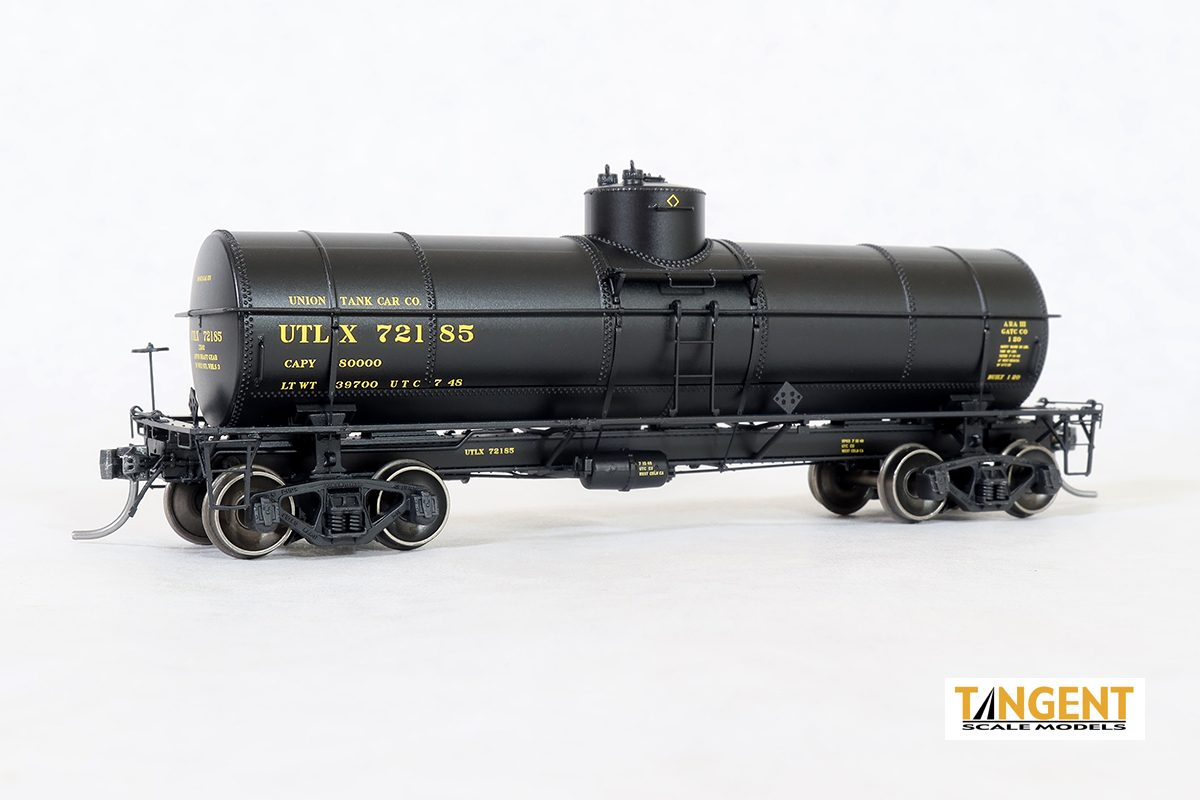
UTLX 72185 - Third Run GA Type 17 8K Tankcar - Tangent linked photo.

I never picked up this version for UTLX, so I'm using the linked stock photo from Tangent's page.  Checking the 1950 ORER, the UTLX 71000-79999 series had 4455 cars of 40-tons (probably 8k capacity), 794 cars of 50-tons (probably 10k capacity) and two other cars with special linings in that series.  The 4455 car block shows that this is one of the larger groups of cars.  I should note that Proto2000 has also produced their ACF Type-21s in this same number series, so not all of the 4455 cars rating at 40-tons are these GA Type-17s. In either case, I'm going to snag one of these new run cars before they sell out.

New run of GA Type 17 UTLX 8k models - Oct 2022


American Car & Foundry (ACF)


Type-21 - Proto2000/Walthers - Late-1990s to Present


10K Gallon


UTLX 10343, ACF Type-21 10K tankcar, photo linked from Walthers website.

Proto2000 released the 8K gallon version first, then a couple years later the 10k uninsulated version came out.   Proto2000 are supposed to be historically correct numbering.  Interestingly, this series overlaps with the new Tangent Models GA Type 17 8k models.  Only 198 cars in the 26-12749 series were rated for 50-ton weight capacity, suggesting how few Type 21 10k and GA type-17 10k cars there can be in these number series.

The older kits that I have of this car show numbers in the 60k-series (UTLX 60350 is one I have), which seems to be correct in that it's a 50-ton car and not in a noted series of 40-ton cars within that series.  The 60000-67999 series consists of 4493 cars of 50-tons capacity (probably 10k gallon cars) with 555 rating at 40-ton capacity (presumably 8k gallon cars).

8K Gallon


UTLX 77640, ACF Type-21 8K Gallon.  Looks like this one is missing the dome platform. JHill photo 2011 LMRC Roster.

Unfortunately, most of my P2K UTLX Type-21s have either not been built or took damage like this one.  Proto2000 are supposed to be historically correct numbering.  Interestingly, this series overlaps with the new Tangent Models GA Type 17 8k models in the 71-80k series, so it would seem that the 4455 cars in that series that are shown as 40-ton, 8k cars are not all the same mechanically.

10K Gallon - Insulated - Not Used by UTLX


Type-27 - Intermountain - Late 1990s to Present


10K Gallon


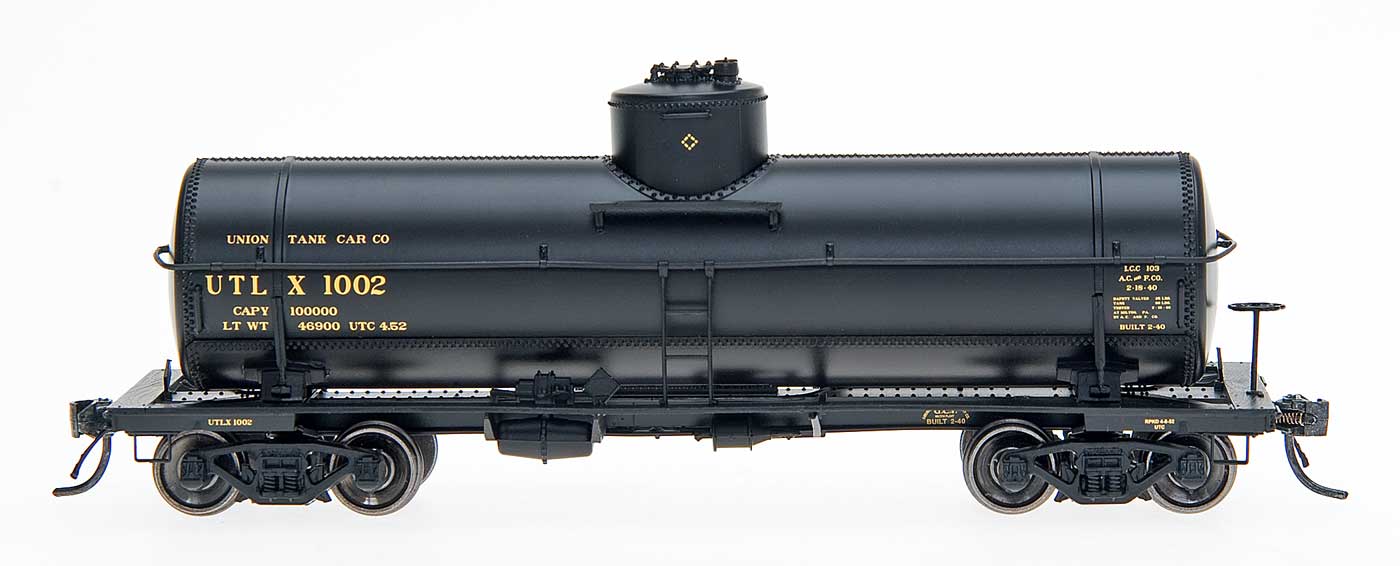
UTLX 1002, Type-27 10K tankcar - IMRC website photo linked.

The ACF Type-27 tank cars are built on a longer frame and smaller diameter tanks than the Type-21s.  The model shown, UTLX 1002, is in the middle of the lower end of the roster and falls within the Note B cars of 976-1026.  Again, a very small group of cars considering the UTLX fleet size.  IMRC currently shows the following numbers available:

Built (Tare Date): Built 2-40, UTC 4-52
Stock Number / Car Number
-37 982, -38 996, -39 1002,
-40 1007, -41 1015, -42 1028

It would seem that the 1028 is two numbers higher than the last 50-ton car and is back in the 40-ton, 8k gallon car number series.


8K Gallon


UTLX 17362, ACF Type-27 8K gallon tankcar - IMRC website photo linked.

The IMRC ACF Type-27 8K tank car is also built on the longer frame of the Type-27 design, with the smaller tank diameter.  ORER shows the 16000-17799 series with 1437 cars of 40-ton, 8k gallon nominal capacity.  Only two cars in the series have notes on being 30-ton capy, probably 6.5k gallon (UTLX 16121 & 16445) and 10 cars of 40-tons with special liners. (UTLX 17001, 17065, 17069, 17211, 17295, 17392, 17567, 17624, 17668, 17705 lined).  So it seems IMRC came up with reasonable car numbers with their research.

Built: 7-37
Stock Number / Car Number
-07 17319, -08 17334, -09 17356,
-10 17365, -11 17371, -12 17382

Previously Released Numbers
-01 17308, -02 17317, -03 17330,
-04 17362, -05 17375,
-06 17389,

1948-1951 LPG Tankcar 11k Gallon - Atlas - Early 2000s


UTLX 96269, 11K gallon insulated, welded, 300PSI LPG tankcar from Atlas.

Atlas produced a new set of tooling in the early 2000s replicating the ACF's 11k gallon LPG tankcar, while a little off-topic from the general service tank cars that I'm talking about in this article, I do want to point it out.

The UTLX 96012-99999 series are the new LPG cars totalling 2274 cars in the 1950 ORER with only 29 cars in the series showing as 40-ton cars, which are probably some other design.  Both cars blocks in the series are classified as TPI = Tank, Pressurized, Insulated.  The Atlas model represents the fairly standard of the late 1940s LPG car meeting the ICC-105A-300-W specification.

Union Tank Car (UTC)


UTC X-3


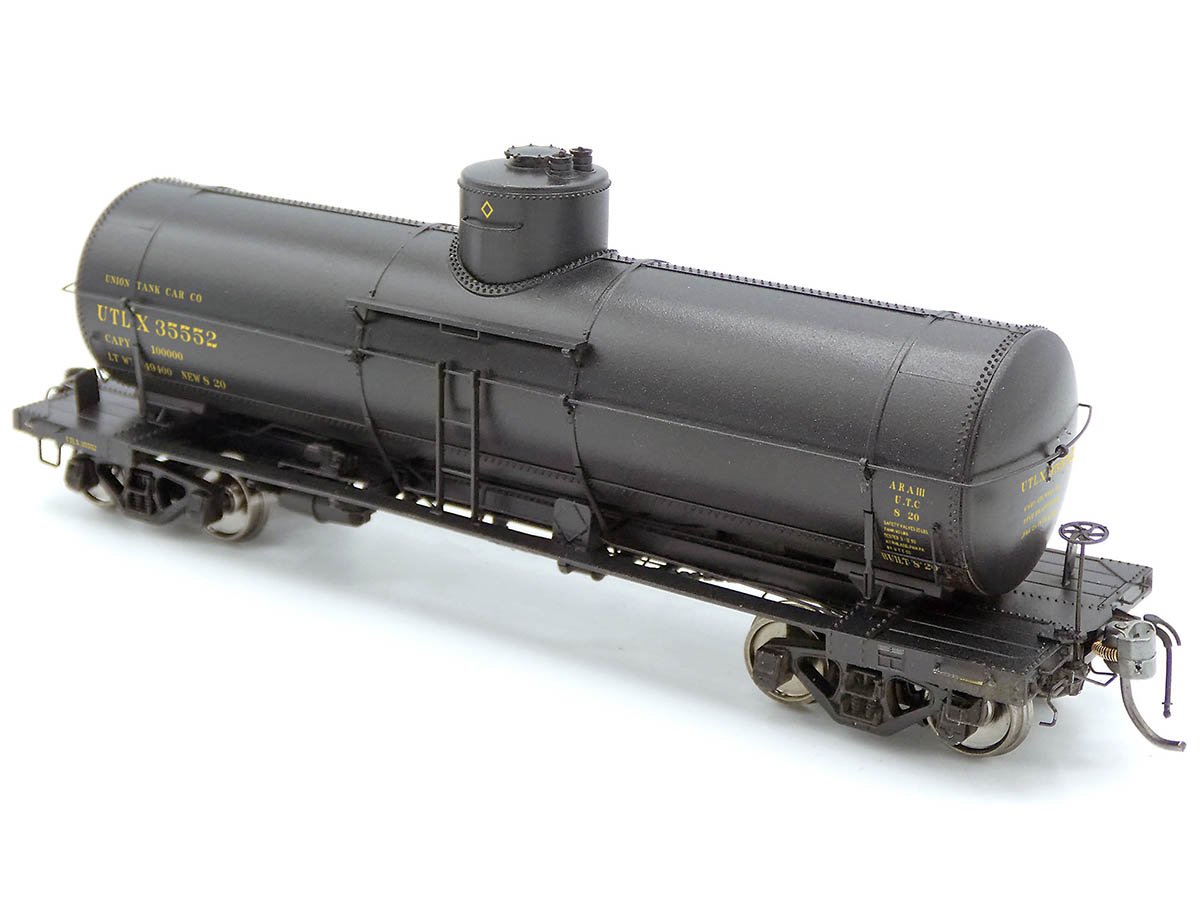
Rapido's pre-production UTLX 10K X-3 Tank car - Photo linked from Rapido's website

The X-3 series of tankcar designs have been offered in resin, but never before in plastic tooling or R-T-R.  So Rapido's announcement that they're doing a 10K gallon UTLX X-3 car is very good news, as we can finally balance out our steam-diesel era UTLX fleets.

10K Gallon - Rapido, new project 2022+


The first release of Rapido cars look like they're numbering into the 26000-42999 series, including 28714 in the 1920s version, 28941 in the 1930s lettering scheme, and 35552 is one of the cars in the 1950s version with AB brakes.  This massive group of 17,000 numbers 6235 cars show active in 1950 with 50-ton (10k gallon) capacity and only 174 cars of 40-ton (8k gallon) capacity in the series.  It doesn't appear that Rapido has announced exactly which numbers they'll be doing as of Oct 16, 2022.  The numbers I meantioned here are what their render-artwork shows and one pre-production 1950s model is 35552.  However, with 13,000 cars of the 10k gallon X-3 design, that accounts for almost 25% of the UTLX's whole fleet.  So we can clearly see how we've been missing this very signature car in the steam era fleet.  Several other leasing companies and railroads besides UTLX are planned in this first release.

Rapido Website Link: UTLX X-3 Tankcar

Among the other leasing and railroad owned X-3 Rapido is also producing besides UTLX, I believe that PX is Products Tank Car.  The PX cars use the UTLX yellow on black standard lettering.

8K Gallon


Only available in resin kit form.

6.5K Gallon


Only available in resin kit form.

In Closing


T&NO 838 with variety of oil and chemical tank cars, Texas Feb. 25, 1952 - Robert Yarnall Richie photo - George Lane collection, digital collection at DeGolyer Library, Southern Methodist University, Texas.

I'm hoping that this blog post will help my fellow modelers learn and develop a roster plan for their layouts which will have a good balance of UTLX and tank cars in general.  If nothing else, to keep a weather-eye out for what models are floating around on the NIB and second-hand markets for the limited production models, such as Tangent or the various P2K kits that have been produced over the last 25 years, but aren't currently "in production" to build a fleet from.  Nothing worse than walking into a hobby shop and having your brain go blank of exactly which cars were right and which ones was I supposed to avoid as "Fobbies"?  Hopefully, this page can be a "oh, yeah, NightOwl did an article on that, let's pull it up on my phone." to solve the question.

Jason Hill


Modeling SP B-50-series Boxcars (Part 5) - B-50-13/14 from Accurail or resin kits

SP Pre-War Boxcar (Part 1) B-50-18/19/20/21/23 classes

SP Post-War Boxcars (Part 2) B-50-24/25/26/27/28/29 classes

West Bakersfield (Part 1) - Laying Out Industries - Shell Oil of Calif, Union Oil of Calif, Pennzoil