Showing posts with label Renumbering. Show all posts

Thursday, October 5, 2023

Common Foreign Freight Cars (Part 1) - Mather Boxcars

I'm starting a new series... I know, I know, you say... what about all the series you've started and not finished?  Well, like model railroads, this blog will never be done!  I've hit on some of the foreign cars already, PRR X31/X32 series boxcarsWWII War Emergency Boxcar36ft Fowler Boxcars - NC&StLNP Double-sheath Boxcars, and Milwaukee "Rib-Side" boxcars.  I'll probably done one on some basics of things like X29 and B&O M-53 "Wagon Top" boxcars.  So while those previous blogs were on specific common types, I'm going a bit more a field with this series of "Common Foreign Freight Cars", into prototypes that I could see coming through the territory I model, or just about anyone models as interchanged traffic.  These cars would be ones that "could show up anywhere" and wouldn't be bad to help 'fill out your roster' with that were either common prototypes, or standard designs which are available in model kit/RTR form (aka, easy to model).

The updated ACY 1295 with chalk marks using the white and gray GellyRoll pens.

Back in the late 1990s, I picked up some wood-sheathed boxcars.  These came from the first series of Proto2000-LifeLike as R-T-R boxcar models, which was very new at the time.  Thankfully they didn't need much work to bring up to standards.  While they look similar to the modern Rapido B-50-15/16s, these are not SP prototype.

Roster 1950


Here's some roster info that I was able to find on-line.  The Mather cars were built with standardized parts and design.  It gives some idea the size of the Mather fleet and also some of the variations in car height, which is new information to me.

7'8" IH cars, P2K models correct
ACY 1250-1299 (50 cars)
C&EI 400-500? (100 cars)
CIM 8000-8454 (453 cars)
IN 2000-2099 (100 cars)
MRS 7500-7599 (24 cars) - 50% total roster of MRS in 1950.
PH&D 1506-1522 (11 cars), 7'10" IH version though, so 2" taller.

8'5" IH cars, taller than P2K models, Sunshine Resin made these (6.1-6.4)
ACY 1100-1199 & 2200-2149 (242 cars), but these are 8'5" IH cars (why P2K lettered my car in this series is weird.)
MWR 1201-1275 (25 cars)
TC 7751-7850 (96 cars)

9'11" IH cars (Sunshine kits 103.1-103.3)
ACY 1200-1220 (21 cars)
MWR 1276-1300 (25 cars)

10'3" IH cars (Sunshine 102.4-103.10)
ACY 3001-3149 (149 cars)
GM&O 7500-7524 (25 cars)
MRS 8000-8024 (25 cars) - other 25 cars in their fleet


It seems that with these differences in height, Proto2000's research in the 1990s were not holding to as high a standard as they were claiming at the time.  Resulting a couple of the models not really being as accurate as we have come to expect 25 years later.  So I will be doing a brief overview of four examples from the 1990s production.

ACY 1195

I have to move this car's number to 1295 to be in the correct series for this height car, see roster above.  I don't know why Proto2000 would make this kind of error, but research in the pre-internet 1990s was much more challenging than these days.
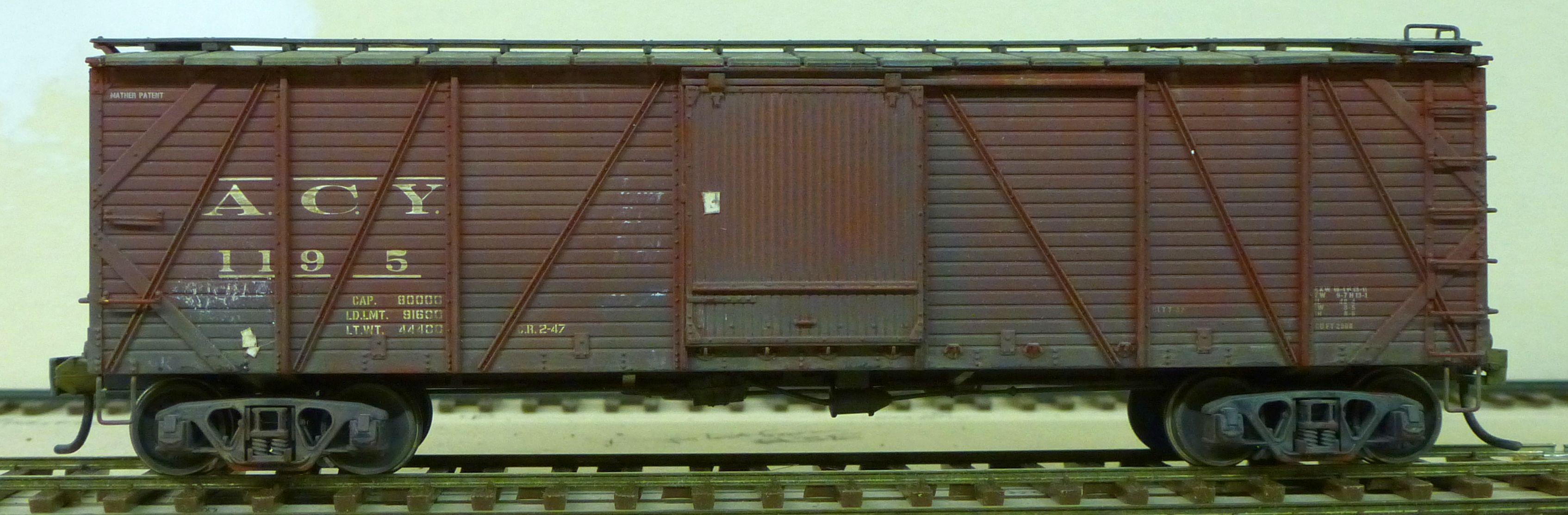
ACY 1195, Mather standard boxcar

The ACY car doesn't have heavy weathering, but mostly just some running grime along the lower carside.  I put on some paper routing cards and a few chalk marks.  Tare date is CR 2-47.

The updated ACY 1295 with chalk marks using the white and gray GellyRoll pens.

In September, 2023, as I was finishing up the Accurail Fowler kitbash, I decided to go ahead and renumber this car to the correct number series for the car's height.  The NC&StL decal set from K4 Decals is very similar in font style and height to the ACY car, so I scratched off the "1" with my No.11 Xacto blade and applied the "2" from the decal set.  I think this photo was before I slightly toned down the new decal, but in the end it matched very nicely on the car.


FtDDM&S 14007


FtDDM&S 14007, Mather standard boxcar

The car has some light chalk marks and some board highlighting with grime.  A couple routing cards are also placed on the carside.  This car is tare dated for CR 3-55, but is preceded by "MSSCO" which I think is the Mather leasing company shops, as some of these cars were leased.  This scheme might not be prototypical in 1950, given the 1950 roster and the tare date on the model... I guess I can hope that it was a lease that started after 1950.

TC 7702


The prototype roster shows these cars should be 9" taller.  Meh, oh well.

TC 7702, Mather standard boxcar

I went into more chalk marks on this TC car, marking loading tallies to the left of the door.  I generally applied a moderate grimy weathering on the sides of this car.  Additional chalk marks around the reporting marks at the left end of the car.  The car's tare date is for MSSCO CR 9-47, so again, I'm guessing another leased car.

PH&D 1509


PH&D 1509, Mather standard boxcar

The PH&D 1509, I kept pretty clean.  They only had 11 cars!, so again I unfortunately found a model that didn't have many cars, so this is another "rare" car to see, you're not going to have a whole train of these.  It looks like some one over lubrication has been applied to the door mechanism.  Minimal chalk marks are applied.  Tare date is for MSSCO CR 4-46.  A couple of routing cards are also applied to the car side.

In Closing


I know single-sheathed foreign cars did still come to the Jawbone in the early 1950s, because of the photo of SP 3237 at Bartlett with a single-sheath Seaboard car.  While not a Mather car, these cars will fill some holes in my foreign boxcar pool to bring the look of single-sheath boxcars, albeit with rather rare small-fleet railroads.  I should also note that these cars are rated as 40-ton capacity cars.

C&NW 32833, a standard Mather single deck stock car by Proto2000.
 
The Mather cars are interesting in that they also produced a large number of cars with the same standard structure as stock cars, both double and single deck cars.  In 1996, LifeLike-Proto2000 produced the stock car kits and I picked up a couple of them.  I was also happy I picked up a couple of the boxcar versions when they came out.  I think there are a couple other railroads that I didn't get.

Walthers took over the Life-Like line and the Proto2000 tooling.  Between the two owners of the tooling they have gone on to produce several more railroad schemes of these cars, including: Illinois Northern, Chicago & Illinois Midland, Chicago & Eastern Illinois, & Manufactures Railway Supply.

Jason Hill

Related Articles:


Randy's Layout Blog - Mathers Boxcars - MRS (green), M&WR (yellow), & CIM (yellow) Proto2000 models. Randy goes into more depth on the mechanical standards and specifications of the prototypes.

Chalk Marks - A New Method - Adding the extremely common prototype 'weathering' to steam-diesel freight cars.


X31 & X32 Boxcar (Part 3) - PRR X31F Turtle-Roofs from Boswer - Double Door raised roof, 40ft


Weathering NP 11661 - A Rapido Double-sheath Boxcar - A standard design used by NP in large numbers.

36ft Fowler Boxcars - NC&StL 15337 (Part 2) Details & Decalling - Accurail's plastic kit (and bashing)

Milwaukee "Rib-Side" boxcars - Accurail and Rib-Side models, the 'clasic' steel car design, unique to Milwaukee Road.

Freight Car Index Page - Overview of all my freight car modeling and kitbashing articles.

Sunday, September 24, 2023

Walthers 50ft Auto-Boxcars (Part 2) - Renumbering GN Cars to Correct Series

In the first installment of this series, I just did a general survey of the various Walthers 50ft Auto-Boxcars that I had.  Sadly many of them aren't correct, but in this post, I want to address one of the simpler fixes to get a couple of the cars into more 'historically accurate' number series.

One of the nearly completed Great Northern 50ft OB Auto-boxcars by Walthers, from the early 2000s.

These cars needed a bit of work, so lets look at what's involved with updating and correcting a couple of issues with the stock model.  I'm not going to get into the odd brake equipment arrangement in this post, as I don't think it's the first think I look at on a freight car like this.  Even if the model is going to be a stand-in, I would like the primary exterior visible parts of the model to be mostly correct, i.e. roof, ends, sides.

Edit: Doug Polinder pointed out in a comment to me that: "the model is a Howe truss. GN's cars were Pratt."  So at best these cars are really going to just be 'stand-ins' for the GN prototypes.  Sadly this is one aspect that the ORER fails us, using it as the only research material.

Historical Data


Pre-relettering look of the car in the GN 41700-series.

To find out if the car's even existed and had the right door arrangement, I turn to my Westerfield Models CD of ORER 1950 fleet data.  Under the Great Northern, I can see that they do not have the stock model road number listed.

Clipping from 1950 ORER - No 41000-series cars active on the GN this year.

Great Northern's entry in ORER 1950 does not show the 41900-series is empty by 1950.  However, don't give up hope on your model yet.  Search the rest of the company's roster.  There may be another series, or the original road number may have been changed during a rebuild, etc.

However looking at 43500-series we find double-door 50ft boxcars which should match closer to the Walthers model.

 The ORER does show 43500-43899 series show steel frame, 12ft staggered-doors. The 43900-43999 are similar, but also show full end door. The Walthers models come with end-doors as an option in the kit, so it would be possible to model either series if some minor decalling and renumbering was done.

Renumbering


So I'm doing some renumbering of the GN cars that I have into the 43k series, which should be easy to change the 1 to a 3.  The 43500-43899 and 43900-43999 show as XM (General service boxcars) in the AAR Mechanical classification column.

Removed the "1" with a No.11 blade scraping carefully.

I started the renumbering work with a No.11 X-acto blade carefully scraping the surface just down through the pad-printed ink of the "1".  If I go too far, a small drop of darkened FCR paint works to fix it, although the new "3" will be covering most any scratches that happen.

The new decal in place with a bit of water still around.

I'm keeping the renumbering simple with Micro Scale's Block Gothic Alphabet and Numbers, White #90051.  The 9" lettering is what I'll need to change the side road numbers.  If your decal collection has a more "GN" standard lettering style, then obviously it's better to use that.

Buckled End Joints


One of the problems of putting the optional ends on is getting solid joints in the corners.

Given that I built these models about 20 years ago and some of them saw years of service, getting knocked around, the ends were starting to come loose.  So I wicked in some Tamiya Liquid Plastic Glue, which is lower viscosity than water into the corners of the ends.  Then I carefully pushed the end in to get the mitered joint to close.  

After closing the end up with liquid plastic glue to secure it.

The end looks much better after closing the openings.  A little bit of plastic actually squeezed out from this process, but that's easily cleaned up.  I did a little wash with water and AppleBarrel 20512E Burnt Umber to dull down the new white decal to match my previously weathered numbers on the cars.

Adding Tare Station & Date


I also need to add some basic 'tare dates' to the cars.  This is a station code, month-year stenciled onto the side of the car, usually in the panel just inboard of the car's weight data block to show when the car was last weighed to 'zero' it.  This allows the clerks working the car scales to be accurate within 200 pounds of the car's loaded weight when billing cargo by weight.  The weighing also allows the railroads to detect over-loaded cars which are a safety hazard and could cause additional wear and tear on the engines, infrastructure, and bridges.


The Great Northern has a very odd system of station codes, using an alpha and sometimes a number as well.  Some of the great past researchers of railroad history have documented these codes and what they station they represented, so I'm able to 'build' plausible station tare date codes for my models.  One GN car that I've done already has A-1 on it.  I made it out of some spare 3" stencil white decal "A" and a "-1" from the January month of a decal tare data set.

Operations Notes


ATSF 140 BK-4-H Cliff Jan 8, 1953, (at LMRC in 2018, Jason Hill photo)

Most of these GN cars traveling to Southern California would be in the lumber trade with finished lumber in these big double door auto-boxcars.  The routing usually would be GN, then interchanged to the WP at Bieber, then to the Santa Fe at Mormon Yard (aka Fresno), before routing to Southern California on the Santa Fe on symbol 'GWS' over Tehachapi.  Eastward routed cars onto the Santa Fe, would be switched over to N-34 or BK-symbol at Bakersfield to Barstow, then they would be worked into the eastward symbols from there out of San Bernardino.

If it was heading to a Southern Pacific destination, the car may have be interchanged at Bakersfield to avoid additional congestion in the LA basin.  So this ends up being more of a Santa Fe-centric modeling post for today, but the skills are good to learn for any prototype modeler that needs to do renumbering of the freight cars.

Open Doors or Closed Doors?


GN 43741's Left side with doors closed, representing a loaded car.

One of the nice aspects of the Walthers model is the option to model the car with the doors open.  While normally, you don't want cars running around loaded where the stuff inside can fall out or be stolen, often the empty car doors wouldn't be properly secured.

While the Right side of GN 43741's doors are modeled open, for returning empty towards home.

This lead to a tendency for the doors to open themselves with the slack action in the trains.  On layouts with reversing loop staging, it is possible therefore to set up one side of the car as the "Loaded" side, and the other as the "Empty" side.  At La Mesa Model Railroad club, this trick is really only visible in two places (Caliente-Tunnel 2 and at Walong on the Loop).  

More Tricks!


For discussion during a video shoot with TSG Multimedia, I cut down a couple OwlMtModels 3004 lumber loads to make a lighter weight faux load for the Walthers boxcar.

In one of the TSG Multimedia videos I filmed a number of years ago on the new OwlMtModels 3004 lumber loads, I talked about putting them inside of boxcars in a cut-down form.

OwlMtModels 3004 Lumber Load inside Walthers DD boxcar.

So that's always an option too if you want to show an open door as the load and claim the closed door is empty!

SP 67789 with a stash of 3004 lumber loads hiding inside at King Lumber in Bakersfield, at LMRC. Jason Hill photo circa 2018.

Another option is the photo below, where I staged a photo at King Lumber to show the car being unloaded.

Pondering future options, it might even be possible to put magnets inside the lumber load to remotely move them back into the ends of the car to hide them. - Although, I've not actually tried this --- yet.

In Closing


The majority of my cars are now in good shape residing in the 43000-series!  However, one now has a new problem.  Next time I'll be having a closer look at the 43900-series cars which need end-doors.

Redecalled GN 43952 with tare date added.

This car is now renumbered to the correct 43000-series from the 41000-series, however now the 43900-series should have end-doors.  Not a problem as these cars came with the option for end-doors.  So I'll be digging out the old spare parts from 20 years ago to rebuild the A-end of the car, seen at left in the above photo.

Jason Hill

Related Articles:


Modeling Auto-Boxcars (Part 1) - Walthers 50ft Double-Door Single-Sheath Auto-Boxcars - An Overview

Weathering NP 11661 - A Rapido Double-sheath Boxcar - Some basics of weathering with Acrylics on double-sheath boxcar.

ATSF 129872 WWII War Emergency Boxcar Weathering with Pencils and Acrylics - Continuing the weathering on a single-sheath boxcar with Acrylics.