Showing posts with label Research. Show all posts

Friday, November 17, 2023

New Series of Structures from OwlMtModels Under Development

Just a quick cross-post from OwlMtModelsNews Blog Page

Owl Mountain Models is working on several fun projects which have been behind closed curtains until now.  The Owenyo structures which we need for the demo/photography layout will be made available in very limited production to meet reservations, which are open as of 2023-11-17.  No down-payment will be required, as we're still early in development of the CAD models.  Both HO and S-scale versions are planned to be offered.  Price is currently TBD until designs are finalized and we get quote from 3d printer.


Researching this structure has required many hours studying photos, aerial photos, and modern archaeological measurements.  We want to produce the best kits, balancing details and final finish looks.  This results in currently planning that the upper boards will be stain-able strip-wood, while the bents and lower structural members will be 3d printed with NBW details already in place.  Basic wood-effects should be pretty easily added to the 3d printed resin parts, like the finishing on our plastic lumber loads.


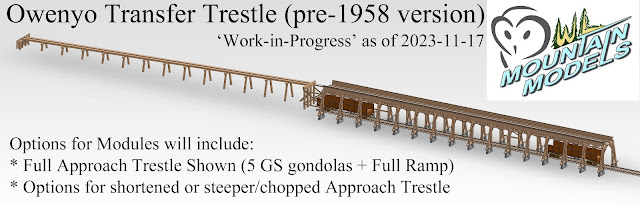
The full length of the trestle with NG approach from level grade over the SG Tell-Tales is over 7 feet long!  That's why we'll be offering the trestle as modular pieces, so that it can be fit onto smaller layouts.  The OwlMtModels photo-demo layout trestle will be shortened to only 4-GS gondolas for the dump section and most of the Approach Trestle will be truncated into the backdrop wall.

High-angle view of the dumping section of the trestle.

Jason's been working hard looking at all the photos he can to check for the details.  The CAD allows all the pieces to be worked out in 3d, resolving and solving questions about the prototype photos, which he's not seen solved in previously published drawings. Hopefully, this will be the best researched model of the Transfer Trestle yet produced.  Research is still continuing in 2023.

Water Tank


Rough CAD rendering 2023-11-17, subject to redesign and detailing.

The water tank at Owenyo was moved from Diaz in 1952 according to the Employe Timetable station ans services list.  There's still much more to add to this CAD model, but it will make an amazing little tank for any small engine facility.  The footing should be about 2.5" diameter and estimating about 4" tall for HO scale.

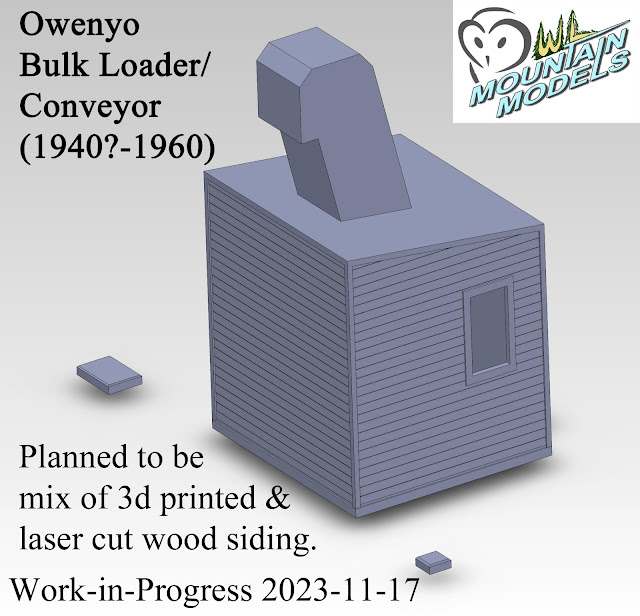
Bulk Loader/Conveyor Shed


Partly drawn as of 2023-11-17 work-in-progress

Another structure which is researched from many photos and modern archaeological research of remains.  This structure will also make a great little loader for boxcars or covered hoppers on any small layout, for those not modeling Owenyo specifically.

Pump Houses


We have some research on the Water Pump House and photos, which should allow a model to be produced.  As of 2023-11-17, Jason hasn't started the drawings for this structure.  The Fuel Oil Pump House will also be made, but research is minimal at the current time, and the CAD model has not been started at this time.

Reservations Contact


Currently, two customers have expressed interest in kits for these parts.  Please show your support by contacting sales@OwlMtModels.com to submit reservation, specifications of what size and scale is desired.

- End Cross-posted Article - 

Jason Hill - OwlMtModels

Wednesday, November 1, 2023

SP Jawbone Branch (Part 39) - A Ferro-Equestrian Archaeology Field Trip

A friend of mine said a number of years ago that he was a ferro-equestrian archaeologist.  That is a study of iron horse historical places and remains.  This post is another of my small ventures to one of the places where the ferro-equestrians once roamed.

Looking east to the mountains which will be my backdrop for Owenyo

So on the return from the Southern Pacific Historical & Technical Society 2023 Convention in Bakersfield, I decided to stop over in Lone Pine and then drive up the east side, stopping at Owenyo to do some in-person research of what remains of the buildings.  This would give me the chance to make drawings of the remains to build the models for my Jawbone Branch layout.

Edit 2023-11-02
Blueprint of Owenyo - rick olson 01_owenyo blueprint_sml owensvalleyhistory,com

A recent find on the owensvalleyhistory.com website, helps see the locations of everything.  I'm happy I found this Nov 2, 2023, as I'll be able to help scale out the size of the buildings and some of the placement.  The original date is from Dec 31, 1923 and the revision date for the leasing of three structures is July 19, 1940.  The 1923/1940 dates explain why I don't see the water tank or the transfer ramp between the two gauges in the lower right corner.  Also interesting is the "To San Francisco to the left and Hazen to the right, so it must be SG to SF left and NG to Hazen right - perhaps because they're thinking to extend the standard gauge?

Transfer Trestle


Owenyo Trestle - SG side - unknown calander photo - Ronald Grau collection

I spotted the abutment remains from the road and pulled off.  Walking over, I found that the NG and SG around the area were actually on a bit of a fill.  Even the trestle approach grade was rather in a pit as well, probably from the old days when they dug down to get some more solid ground to put the trestle bents on.

Sadly, not much left of the transfer trestle other than these footings, looking northward.

I took some time getting out and measuring the dimensions of the foundations.  This should be the last piece of information, which should allow me to build an accurate model of the trestle for my layout.

The footings looking south, into the sun.

The SG track's pit has collapsed somewhat, as the transition from the grade to the trestle over the SG track has sluffed into the pit.  Although there must be some level of washing out the lower parts of the pit, because on a couple of the concrete footings for the trestle, even the connecting concrete is visible.  I think this means that the floor is about a foot lower than it historically was.

Owenyo Transfer Trestle - owensvalleyhistory,com - sp_narrow_g37a_sml

Looking at the above photo, shows that at the time it was taken, the wood bases of the legs are even with the ground, which means that concrete footings are completely buried.  The concrete footing bases seems to then be flush with the ground in the pit.  I'll be analyzing this more and covering the results in future posts.

Tell-Tail 


Tell-Tail from 1954 - cropped - unknown calendar photo - Ronald Grau collection

With any vertical or horizontal obstruction the railroad had to put tell-tails to warn anyone riding on top of the cars that there was a problem if they stayed standing. - To my eye, I think this tell-tail isn't low enough to provide proper warning, but the ETT warns specifically about not shoving boxcars, etc onto this track.

The remains of the foundation for the tell-tails.

All that's left today is three and a half concrete blocks with rusting torched off pipes for the tell-tail.

Old Owenyo Road


60-10-Goods-Transfer-Platform-_sg-on-far-side__-Owenyo-V_2 - PacificNG

The old turn-off from the road into the area behind the Narrow Gauge still has remains of the old 'oiled dirt', which is still sticking together even after 65+ years in the desert.  

Owenyo transfer decks with road crossing looking north - owensvalleyhistory,com - ebay35_owenyo_sml - (Lightened)

As I pull up and park, the footings of the water tank are visible immediately off to my right, and a set of foundations to my left catch my eye.

Bulk-Transfer Conveyor


OWRN boxcar Owenyo Perlite Transfer from SPNG, SPMW water cars, Sept 19, 1950 - owensvalleyhistory,com - mark_van_klaveren04_sml

The transfer facilities at Owenyo include this bulk-conveyor at the south end of the main area.

Remains of the conveyor as it was dismantled in 1960. - Rich McCutchan owensvalleyhistory,com - daton01_t

Sadly, the end came for the conveyor in this 1960 view of the whole facility being destroyed.

Owenyo Conveyor Foundation - NW Side

Now, all of the foundations that remains of the bulk-transfer conveyor building.  Thankfully these cast concrete bits are still there!  I spent some time making drawings of this to base my model on.

Water Tank


Water Tank - Owenyo station with tank and 5501 RSD-5 - Andrew Brandon collection - Cropped

Turning towards the water tank and heading that way, to my surprise I find several other things in the area.  

Tank foundation remains at Owenyo

A couple of plugged concrete slabs, with what looks like remains of underground piping - perhaps part of the pump house-water tank or connection to the long gone SPMW water tank cars. 

Water Pump House


Owenyo SG water Tank - 1960 - Alden Armstrong - Cropped - 

The foundations of the pump house are there as well.  Thankfully, I think I can work out the base for my model now.  Looking in the foreground, left-front of the pump house tower shows the cistern that is still there today.

Water Pump House foundation remains

Also there is a large cistern which is half covered by a mound of dirt... almost in the road, where it crossed the yard.  I'm not sure if that was there 65 years ago, or if it was more recent.  There's an open cover about 12" in diameter, and the sounds of hollow space below.  I stayed clear of it, as I didn't want to find myself down a well or the like.

Company Houses?


1944 Fairchild Aerial photo - cropped

After the pump house, I decided to walk up past the company buildings and see if I could locate anything of their footings... however with very large bushes overgrowing the whole area, I decided not to look very hard.

Oil Pump House


Fuel Pump House & Tanks - Cropped Owenyo Hotel decom - Rich McCutchan - owensvalleyhistory - c_n_c40_owenyo_1960_859_sml

Next up, as I was walking to the north, I decided to continue and see if I could locate any of the old engine spot remains, and maybe get more information on the oil tanks and pump house located on the north curve of the wye.

Engine Spot remains.

I was able to find a very thick slab of oil-dirt or asphalt covering between the long-gone rails, but still covering the ties, which is where the steam engines sat 100 years ago, dripping steam oil and grease for nearly 40 years.

Engine Spot - end of track crossed-ties?

It seems that at some point the SP gave up on the wye, probably after the end of steam on the branch, I'm guessing around 1956-1960.

Remains of the Oil Pump House - Not much left of the tank structures.

There were a couple of small foundations and other patches of asphalt/oiled-dirt, but not anything that I could really recognize as anything of what the photos once showed there.

In Closing & The Long Trip Back


After about 2 hours looking around, I decided it was time to get going.  I quickly set up my tripod and shot a series of photos of the White Mountain range to the east for when I go to make the backdrop.  Then I hopped in the car to get going.  In hind-sight, I should have returned down to CA-136, and back to US 395 at Lone Pine, but feeling adventurous I continued north. 

Who says there's no water in the desert? Manzanar Road 2023-10-30 closed!

The Manzanar Road was closed due to flooding, so it forced me to continue on for another 5-6 miles of worse dirt road and old railroad right-of-way. Unfortunately, the heavy winter of 2022-2023 which kept snow on the ground for over 90 days at our house in Nevada, also did a number on these back country trails as well.

I would not recommend trying to drive the north-side access drive in anything other than a Jeep or 4-wheel pickup truck (which I happened to leave in NV!).  I did get through it, however with some new pin-striping and nearly getting stuck in soft sand about 5 times.  At approximately 4-5 places my vehicle found high rocks or badly worn tire tracks which could have high-centered lesser cars.  At one point the road was not passable to my vehicle, due to a fast rising trail of nearly 8", which would laterally high-center me.  This  requiring me to back out about 400 ft, turn around and then back track another 1/4-1/2 mile, then break trail across to the other road, about 50 yards away.  

Once I was able to get onto good road again at Citrus Rd, the rest of the drive back west to US 395 at Independence was without incident.

Jason Hill

Related Articles:


SP Jawbone Branch (Part 26) - Engine Spot & Water Track Detailing

Jawbone Branch Index Page - Main index for my Jawbone Branch (only) blog page.

Saturday, January 8, 2022

SP F-70-10 New Deck Color? New Evidence!

There's been debate about the proper color of the new decking of the SP F-70-10s.  Without good color photos of their construction, it's been impossible to determine.... until now!

New Evidence!


I was watching SP Railway: Behind the Scenes 1950s Educational Documentary WDTVLIVE42 video and found the section starting at 5:08 with assembly of wheels and trucks, then moving to the construction of the bodies and ending at 7:22 with the decking of the new F-70-10 flatcars in Dec, 1953 and into 1954.

SP Railway: Behind the Scenes 1950s video, time index 7:03

In these photos the brown wood colors show a bit more.

SP Railway: Behind the Scenes 1950s video, time index 7:13

It appears that the boards are dark, but also have some brown color still in them.

SP Railway: Behind the Scenes 1950s video, time index 7:18

However, on this car the board look VERY dark, and even shining black spots, which does suggest creosote.  So let's see what I can do with the RedCaboose/SPHTS F-70-10 model decks.

The Model


I want to model my cars on my Owenyo Branch layout for 1954 at the latest, so these cars will be the newest of all the cars I plan to model.  Certainly if I was modeling 3-10 years later the other deck weathering techniques I've shown on my assortment of F-50-series OwlMtModels flats come into play.

RedCaboose/SPHTS F-70-10 with some light weathering on the 'straw' color molded deck.

I'm not going to go into a huge amount of detail on my deck prep and basic weathering.  This is going to be an interesting weathering, or I should say, non-weathering of the deck to make it look like a first year deck.

Kitbashed F-70-10 deck (top) and new tooled deck (bottom)

I did some light scuffing with some sanding stick to give a bit of 'tooth' to the deck to hold the washed paint.  The first color used is AppleBarrel acrylic paint (21490E) Pavement, and then a thinned wash of (21985E) Black.  A bit of (20511E) Brown Oxide was mixed into the last wash of Pavement and Black to shift the deck color towards the brown side.  At this point, I'm setting the deck aside to fully dry for several hours.

SP 142617's updated deck finish with more black and patches of gloss per film clip.

I came back and add a little bit more brown and black streaking on parts of the boards.

Next is a shot of clear-coat to seal the existing colors down before a final black wash for the boards.

In Closing


Hopefully this info is useful for those of us modeling F-70-10 class flatcars.

Jason Hill

Related Articles:


Kitbashing OwlMtModels (Part 4) F-50-Series Decks - Link to Deck Distressing and Weathering video.

Wednesday, March 10, 2021

SP Jawbone Branch (Part 15) - Passenger Ops & ETT Research Notes

I've been tinkering with a 'crazy idea' of passenger operations on my Jawbone Branch layout.  This has led to digging more into the research of the Employe Time Tables (ETT) for the Mojave Subdivision Owenyo "Jawbone" Branch history.  So on with the question....

Passenger Operations?


Little Lake with the arriving passenger train lead by SP 1433, circa pre-1938 - owensvalleyhistory.com - susan_stanton03 (Cropped)

Will I get to have passenger operations on my layout?  Well, it certainly would add a dash of style and color.  I've always planned to model the occasional passenger excursion trains which ran in the 1948-1956 era, but let's take a closer look at what options I have for the earlier passenger and mixed schedules.

Time Tables - Mojave Sub-Division


I'm still doing more researching on the earlier pre-1938 era operations from which time the above photo of the SP 1433 dates from.  Wooden coaches and the 1433 was renumbered as the Second 1500 in 1938, so that gives an idea of when passenger-only consists were run.

San Joaquin #158 1938-02 Owenyo Branch - SheldonPerry collection

Moving forward in time to 1938, the SP shows four scheduled trains on the Jawbone.  Nos. 802/803 were the "Searles Turn" working from Mojave to Searles to interchange with the Trona Rwy.  Nos.788/789 are shown as Mixed trains to Owenyo with flag stops as needed along the run. Running times are 6:30 eastward and 7:15 westward.

Notice that the Searles train (Nos. 802/803) is out and back to Mojave before the train from Owenyo arrives (No.789) and then departs again (as No. 788).  I find this interesting, as it basically shows that the local crew was resting each day in Oewnyo, except on Sunday when the schedule does not run.  

1941 Owenyo Branch Employe Timetable, note the telegraph codes! - SheldonPerry collection

The 1941 ETT is the last one showing Nos.788/789 as mixed trains.  My guess at this point is that they were kept until the end of the war.  Then the new ETT for 1946 changed the passenger operations to reflect the post-war operations moving forward.

From the previous conversations I've had with knowledgeable folks on the Jawbone operations and reading Vincent Cipolla's article in SP Trainline on Mojave, the Owenyo job usually went on at Mojave in the evening 6-7pm, and went off duty in Owenyo the following morning.  Returning to duty after 8 hours and arriving back at Mojave the 3rd morning around 7-8am.  It would seem that after the war with the discontinuance of the scheduled operations on the Jawbone the crews were consolidated back to Mojave.

Sept 1950 ETT - SheldonPerry collection

By 1950 all scheduled trains have been removed from the Time Table.  Three water tanks are active at this date.  Linnie and Bartlett are both showing as additional stations.  Interesting that Little Lake shows as 30 car siding, and Owenyo shows as a 40 car siding.  I'll be modeling Owenyo as only around 26 cars long.  Little Lake will probably be around 20 cars, with my train lengths this should still work out.

April 1952 ETT - SheldonPerry collection

By April 1952, the water tank at Diaz (MP 512.8) has been removed from the ETT.  Leaving the water tank at Haiwee (MP 484.1), Letlier (MP 450.0), and Cantil (MP 402.5).  However a new tank at Owenyo (MP 523.0) is now active supplying the far end of the branch.

April 1953 ETT - SheldonPerry collection

September 1953 ETT - SheldonPerry collection

April 1954 ETT - SheldonPerry collection

By April 1954 the water tank at Letlier (MP 450.0) is now gone, leaving only the tanks at Cantil (MP 402.5), Haiwee (MP 484.1), and Owenyo (MP 523.0).

List of Water Tanks & Histories

MP 402.5 Cantil (from construction until well after 1954)
MP 450.0 (Water Tank only) Letlier (Removed by April 1954)
MP 484.1 Haiwee (from construction until well after 1954)
MP 514.3 Diaz (Water Tank only) - (from construction until April 1952)
MP 523.0 Owenyo (New water tank in April 1952 - could this be the Diaz tank moved?)

The changes to the watering options are interesting.  I am still trying to nail down if the tank at Owenyo was fed by moving water tank cars from Diaz and the other water tanks to cover Owenyo's needs, or if there was a well at Owenyo.  I rather doubt the Owenyo tank was supplied by a local well.

Most of the photos of the excursions after 1952 show there are water cars for each engine, not always coupled to the engine (canteen service).  Also there always appears to be a water car at the tank(s) at Owenyo, suggesting they are being actively used.

There's the photo on Page 24, SP Trainline issue 135, showing SP 5300 switching Owenyo, possibly departing, in early 1953 with a SPMW water car right behind the diesel!  Certainly not needing the water for the RSD-5 on the Jawbone, but the SPNG was still running steam, so was this water for the village of Owenyo or the SPNG engines?  Was the SP 5300 taking the water car west to refill at Haiwee?

Sometimes there's always more questions than you can answer!

Modeling a Consist for Nos. 788/789 Mixed, circa 1941


Of interest on my modeled part of the Jawbone in the 1941 ETT for the Mojave Sub's Owenyo Branch showing schedules for No.788 and No.789 mixed trains.  This mixed train I believe are the ones photographed at Owenyo during the daytime layover during that era.

SP 2578 No 788 - Owenyo 1940 - Phil Serpico - owensvalleyhistory.com southern_pacific015_sml

Obviously by time of the 'Mixed' operating on the Jawbone, the train consisted of whatever freight needed to move plus two passenger cars tacked on instead of a caboose.  Notice the two passenger cars at the end of No.788's consist of 11 cars in 1940, above.

Owenyo with the RPO & coach laying over looking north - owensvalleyhistory.com - ebay35_owenyo_sml

In this view the engine in the distance, probably a C-class.  Many single-sheathed boxcars, with a T&NO boxcar and an SP B-50-12 class closest to the road crossing through the platforms. Note the engine-service fuel oil tanks next to the C-class.  The ETT shows that Owenyo and Mojave have oil, which is run with a steam powered pump.

RPO-Baggage Car


SP 5187
SP 5187, a 60-BP-30-1 RPO-Baggage kitbashed from MDC-Roundhouse parts

There are some modeling options for 60-BP-30-1 available in brass, I have an old MDC kitbash that I've tinkered on and off with for the last 20-25 years.  This is about how it looks currently.  I left it with the RPO door being raised and adjusting the paint and decalling.  One of the 4'10" baggage doors needed replacing as I previously had used the double door 7ft option, which is incorrect for the 60-BP-30-1, so I fixed that.

Currently, the changes I need to do to finish it include upgrading the trucks to Walthers 8ft Pullman type, installing diaphragms, and underbody work.  I'll probably also install an OwlMtModels 30ft RPO interior.  I'm not sure I want to repaint the letterboard yet again to decal as SP Lines.

Ken Kidder?!
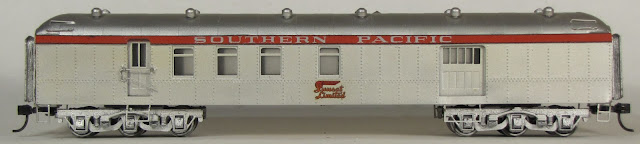
Ken Kidder brass 60-BP-30-1

A friend several years ago traded me a 60-BP-30-1 from Ken Kidder.  The model is arronously painted for the 69-BP-30-series cars used on the Golden State.  The model will have to be repainted.  While the window and door arrangement is more accurate, the roof profile is very flat, and about 6" too low!  The roof is a major pain to correct on these cars.

The Ken Kidder car above of course will need the trucks changed out to Walthers 4-wheel Pullman 8ft models.

SP 1190 - Ken Kidder's low roof shown next to correct height SP 6102.

Generally in the past, I've decalled Ken Kidder cars to be riders and other cars which usually will not be seen with full-contour roof cars.

Coach


SP 2178
SP 2178, a typical 60-C-9/10 class all-steel coach, as produced by Soho.

One option for my coach is a late-series Soho 60-C-9/10 class car like the SP 2178, shown above.  Most of the Soho 60-C's that I've done which have plated over transom windows are in SP with post-1946 lettering.

SP 1005
SP 1005 Chair Car

Another option is the transom-windowed Soho 60-C-series cars, such as SP 1005 above, but the SP 1005 was not a chair car until later WWII era, when it was returned to passenger service from use as a caboose.


SP 1190
SP 1190 - Ken Kidder coach

Another option is a Ken Kidder model, also with the low-roof like SP 1190, shown above.  The 1190 is possibly a better option as it is already painted in the SPL scheme for 1941 operations before the June 1946 change which dropped the "LINES" from the letterboard.

In Closing


Could I run a passenger train like the "Shasta" to Owenyo?

Well, while I haven't made any choices in this post that are carved in stone, there certainly are some interesting questions and options that are open to my operational planning.  At the end of the day, judicious use of Model Railroading, Rule 3: "This is my railroad, and I'll do what I want." can be very liberating.  The research of 'history' allows a much easier way to import a sense of reality than 'inventing' everything myself.  However, if I want to run a 'regular' passenger train after 1946, because of "Reasons", then I can.  (BTW, for reference, Rule 1: Model Railroading is FUN.  Rule 2: If in doubt, refer to Rule 1.)

Could I have a consist like the one above running to Owenyo, but maybe with a T-class?

Would it be too wild to say that the high-class customers at Little Lake would charter a couple of Pullmans to bring customers from LA?  Maybe.  A 4-8-2 will certainly be too big for my 26" radius wye at Owenyo, plus historically only an Mk-2/4 and occasionally an Mk-6 could go that far out on the branch.

Mk-6, SP 3266, leads an excursion past Olancha with excursion 1952 - Phil Serpico - owensvalleyhistory.com - southern_pacific012_t

Then of course there are the actual excursions that were run!  As they say, "At least I have options."  

Jason Hill

Related Articles:


Jawbone Branch Index Page - List of all my SP Jawbone Branch modeling posts.

The "Shasta" - Revised Pike-Size Passenger Train - My first consist blog post, on the Shasta - A back-water passenger train readily modelable with a baggage car, chair car, cafe-lounge, and Pullman which will fit most layouts!