Showing posts with label IMRC. Show all posts

Wednesday, October 18, 2023

GN 10784 Plywood Boxcar - Quick Weathering

Time to dive into weathering my new Bridgetown 2023 acquisition, a GN "Plywood" boxcar.   Normally, I've thought these cars were gaudy and strange.  

Orange... in a freight?!

To be fair, I'm not much of a GN researcher, but I do want to model GN cars as foreign cars showing up on my Southern Pacific layout.  Over the last two years or so is that these cars did run across the area that I model, namely Tehachapi and even the Jawbone Branch.

Great Northern Paint Schemes?


IMRC/IMWX boxcar kit painted in the 'normal' paint scheme for 1948-1956.

While I'm more used to the classic brown GN boxcar fleet, adding this bright orange car will certainly be an outstanding model, drawing attention.  

Timeline of GN paint schemes:
1941: Side Facing Goat Herald introduced. First FT's delivered (first orange and green livery).

1948: New/repainted freight cars use "Great Northern" instead of "Glacier Park" in logo.

So oddly, the IMWX/IMRC kit has the post-1948 herald with the Great Northern, not the Glacier National Park phrasing in the herald.  Orange/Green paint scheme on the plywood car started back in 1941 with side facing goat. - Good to know, I'll have to change the tare date anyway on the brown car kit, which will work to be a 1948 repaint, probably just remove the "NEW" and leave the "F" date.

IMRC 46055-03*, a RTR GN "Plywood" panel boxcar in orange and black.

These cars were built in 1947 at the St. Cloud Shops with the upgraded post-war steel ends, and retained pre-war design of panel roofs.  It looks like there were two groups of cars, one of 500 cars built in 1945, then 400 cars in 1947.  The GN 10784 would be in the second group of 400 cars.  It would also appear that within the first three years, about 7 cars were destroyed and struck from the roster.

GN 10000-series 'plywood' composite boxcars ORER data 1950.

These were some of the first cars built with plywood sides.  Some PFE reefers were also rebuilt/built with plywood sides, but ended up being changed back to other materials within 5-8 years as the early plywoods failed faster than standard board or steel-side construction.  I don't really know what the disposition of the plywood-sided boxcars on the GN, but clearly they existed into the early 1950s and roamed freely.

Minor Repairs


Somewhere along the route from IMRC's Chinese factory to my hands the car seems to have been dropped and had the steel weight knocked loose from the inside of the floor.  Thankfully, there was not very much glue holding the roof to the upper body edges, and I was able to remove the roof to reattach the weight.

Interior with re-glued weight.

I used some standard automotive RTV-Silicone.  Don't forget to be sure the weight is centered on the floor and with a bit of RTV around the edges to hold it firm.  Then the RTV was allowed to gas-off for a couple days before reattaching the roof with MEK (Tamiya glue).

Weathering Goals


Generally, I want to keep the weathering on this car moderated.  The 1947 build date can mean that it showed up on my railroad within the first year or two.  Given that I model into 1954 with RSD-5s, then I could have them with nearly 7 years of weathering.  I'll aim to go with some grime weathering on the lower car, and also some washes on the panel-edges. 

Some basic roof weathering with Pavement and Territorial Beige highlights along the running board.

Dusty/sooty roof gets a bit of typical weathering.  Rain washed-effects of the Pacific North West should play a part in the weathering too, which will extend onto the car side.

Weathering with Acrylics


Right side with weathering starting.  Ladder mud/boot kick marks onto the side.

 The trucks and underframe are Pavement wash and highlighted with Territorial Beige.

Left side with panel lines.

Most of the side weathering at this point is just highlighting the panel edges with grimy wash and a bit of Pavement from Apple Barrel. 

Weathering with Chalk Marks


Right side chalk marks.

A couple light chalk marks for release lever and hand written "Seattle".  Dark chalk mark of "21" at the left end of the car.  I decided to make the sharp dirt/soot drips from the ends of the door track with my new dark gray Gelly-Roll pen against a straight edge ruler.

Left side chalk marks.

On this side I went with a "Mill St" chalk mark and a very faint tally mark set to the left of the door.  I also did the same dark gray Gel-pen marks from the door tracks.  Generally these streaks can be done with a fine brush, but I wanted to try making sure that they were straight by using the straight-edge and pen method.  It seemed to work.  I can also use a bit of 70% iso-alcohol to feather the end of the streak down a bit more.

Routing Cards


On many of my cars starting in October 2023 and moving forward will have a couple of the OwlMtModels 1220 Routing & Grading Cards applied.

Right side with routing card

On the right side I put a simple routing card under the 7 of the car number.  The car's plywood sides could be hammer-stapled to, thus allowing the cards to be placed pretty much anywhere, although I'm sure GN would prefer the clerks to use the card boards, fitted low on the doors!

Left side with routing and a grading card.

The left side has a Grade "B" card over in the right side data block, below the herald.  There's also a routing card placed over the "Mill St" chalk mark.

In Closing


The basics of weathering this car to this point only took a little over an hour.  So don't be afraid to do a "quick and dirty" weathering pass on a model.  

Wrapped up and ready to roll.

I may experiment with some chipped paint showing a section of the plywood layer failing in a follow-up Part 2 post.  I may also make a light pass with the airbrush to blend everything together a bit.

Jason Hill

Related Articles:

Routing & Grading Cards with OwlMtModels 1220 Decals - Prototype Routing & Grading, demonstrated on NC&StL 15337.


GN Paint Schemes - off-blog reference resource

Saturday, October 14, 2023

Bridgetown 2023 RPM Meet - GN Plywood & Unlettered Tangent B-50-28 Boxcars for the Jawbone Branch


SP 4230 leads OCM-7 through the snow approaching Oakridge with a heavy consist of open lumber laden gondolas and flatcars. - Bob Zenk photo

I want to just do a quick report on the Bridgetown RPM meet in Portland, Oregon this month.  I enjoyed visiting with everyone who attended.  Thanks to Bruce Barney, Rod Loder, and the rest of the crew that was able to get the event set up at the Airport Shilo Inn at the Portland airport.  As always, conversations were fast and everyone seemed busy!  I was last able to attend the first Bridgetown RPM meet in 2018.  So after 5-6 years it was great to be able to visit friends again in the greater Pacific North West area.

The second consist I brought is a Valley extra freight with a classic "Deck" & a work consist with a 2-8-0 and a couple SPMW bunk cars, covered previously in early October 2023. - Bob Zenk photo

The models I brought to the meet included a ~40 car OCM lumber train with about 80% of the cars loaded with OwlMtModels Modular Lumber Loads.  The other consist pulled by SP 3666 was a San Joaquin Valley consist with three OwlMtModels Blackburn Sugarbeet Racks on F-50-series flatcars, a Red Caboose composite GS gondola, and the NC&StL Accurail 36ft Fowler boxcar kitbash I recently posted about here.  Unfortunately, I ran out of time during set up to pull out another 10-15 cars which I've been posting on the blog here, which would have included the NP 11661 double-sheath boxcar, a couple of UTLX tank cars, etc.

As my Jawbone Branch really isn't set up to show, let alone photograph, full freight consists of 40-50 cars, it was nice to get out and see some big consists again.  I'm hoping to remember my tripod so I can photograph the full consists at the SPH&TS convention in Bakersfield later this month!

Bob Cromwell's F-50-2 with OwlMtModels Lumber Loads


When I was able to go walk around the other vendors tables and model display tables I found Bob Cromwell's SP F-50-2 (printed by one of his friends many years ago) with a partly built up OwlMtModels 3004 lumber load on it! - Looking good Bob!


I look forward to seeing how Bob wraps this one up with all the stakes and bracing!


Bob's other models included a large number of tank car models from the 1920s and 1930s, all very nicely finished.

Remember that RPM meets are for you to bring your incomplete models to discuss and chat with others about.  It's not all about bringing "finished" models to show.  But like so much in the hobby, there's still stuff to do on the models.  This aspect is one of the main reasons I highly prefer attending RPM meets over any form of 'contest'.  Many of those that come to the RPM meets could and I'm sure have easily one 'contests' that they've entered.  And quite frankly, winning isn't worth it if you don't have friends to share it with.  So RPMs are a place to enjoy, and leave the competition outside.  The only one you're truly competing with in modeling is what kind of modeler, what kind of a person you can become.

GN "Plywood" Boxcar


For the last couple years I've been keeping an eye out for GN Plywood boxcars after seeing the photo below at Little Lake (Consist Photo Analysis (Part 2) - Owenyo Local, Circa 1950), with the train pulling a couple of GN boxcars near the rear of the consist.

SP 2751 at Little Lake 1950  by Serpico (little_lake003_sml) - Owens Valley History,com - Cropped & Enlarged Consist

While the model doesn't have the Superior-hybrid door of the newer announced IMRC run, which I think is what's in the photo at Little Lake, it was on sale for 50% off from Portland Whistle Stop!

GN "plywood" boxcar with Youngstown doors by IMRC.

I like the oddity of having a bright orange boxcar in regular service able to add some "spice" to the fairly 'boring' consists expected on my Jawbone Branch layout.  Yes, occasionally PFE reefers show up, but this adds a bit as foreign boxcars can roam around in the high desert too.

The red and white herald over the orange side is certainly interesting in the lack of contrast normally associated with the GN's paint schemes.

This car is shown in the new scheme from 1947 "as-built".  I may decide to dig up some black reporting marks and put some on, as the 'new' version doesn't appear to have any tare data, expecting anyone needing it to look at the right side data block for the build date.

This 3/4 view shows the A-end's post-war style of Dreadnaught end and plain rectangular panel roof.

I'm not sure how much weathering I'll be wanting to put on this model.  Maybe just enough to highlight the screw details at the panel joints to show that it's not the normal riveted construction.  As my modeling era targets 1946-1954, this car's 1947 build date keeps it mostly in the first few years of the car's existence. 

Left side view of GN 10784 with basic weathering that I'll show in the upcoming blog post using AppleBarrel acrylic paints and some Gel-pens. - Still subject to some revisions and adjustments to the weathering!

Thus the paint shouldn't be 'falling off' yet by any means.  Although I could do a little chipping here and there along the edges of the plywood panels.  I'm sure I'll cover a weathering post specifically on GN 10784 when I get to working on this car specifically.

SP 102856 - Tangent B-50-28 Unlettered - Youngstown Door Boxcar


SP 102856 Bags of Gypsum Owenyo CA Transfer Docks - owensvalleyhistory,com - (sp_narrow_g44b_sml)

Owenyo is certainly the focal point of my Jawbone Branch layout, with probably 80% of the freight traffic heading to or from the transfer platforms or the transfer trestle.  These two photos from 1954 show the three year old car starting to weather some, notably the herald is starting to have some paint failure.

SP 102856 post-war B-50-28 boxcar SPNG Owenyo Transfer Dock 1954 - owensvalleyhistory,com (s-l1600_ebay01_sml) - (Cropped to show only boxcar)

Tangent has offered painted, unlettered versions of their RTR B-50-28 boxcars.  I was able to get one to do the car above.  The car should be the focus of a future blog post when I get around to doing it.

Painted SP FCR version of Tangent's B-50-28 boxcar with 7ft Youngstown Doors.

In my first review blog of Tangent's new B-50-28 boxcars, I introduce these models. New Tangent SP B-50-28 and T&NO B-50-32s - Review

This is the info for the unlettered version of the boxcar I've picked up for the SP 102856.

B-50-28

Built 9-12/1950 thru 6/1951 *
SP 102100-103599, 1500 cars <- Tangent's current offerings - 2023.
SP 104100-105099, 1000
SP 105100-105599, 500
T&NO 59750-60249, 500
T&NO 60250-61249, 1000

Modeling SP B-50-series Boxcars (Part 2) - Post-War All-Steel - Roster including SP 102856

SP Post-War 7ft Boxcar Decals by Dan Kohlberg


Daniel Kohlberg was holding down the Tangent Models table and on the side his selection of decals for use on the unlettered Tangent B-50-28s.

Daniel Kohlberg's catalog of decals he offers - Page 1

It was enjoyable to talk with Dan for a few minutes while I was away from the OwlMtModels table.

Daniel Kohlberg's catalog of decals he offers - Page 2

I picked up his set for various SP B-50-28+ series cars for $12 and will be looking forward to decalling one of my unlettered Tangent B-50-28s.

Dan Kohlberg's SP Post-War boxcar decal sets.

Reverse side of SP Post-War boxcar decal set, which shows lettering diagrams.

I look forward to sitting down and finishing the RTR-pre-painted, unlettered B-50-28 as the car in the photo.  I like having a prototype weathering/details photo to aim for.  I feel it actually makes modeling the 'typical' prototype easier when you have a specific target to make yours look like. - Maybe I should finish other projects I've already started first?

In Closing


One of the Proto:48 modelers at the RPM brought a Fowler 36ft CP boxcar.  I'm building a Westerfield one in HO, so you'll find inspiration in other scales too!

I would encourage all modelers to are interested in prototype modeling to attend one of your local RPM meets, which are held all over the USA on regular basis.  They are not "contests", but more a forum where fellow modelers can get together and share the hobby, discuss modeling techniques, products, skills and help one another become better modelers.  If nothing else, bring your cell phone camera and take pictures of weathering and interesting things that you might like to model someday.

As one of the attendees (railstiesballast) posted on TrainOrders.com recently:

"A fun day, with great clinics and awesome modeling on display.
As an SP fan (and former employee) I could not resist getting a couple of Tangent's new SP B 50-28 40 ft. cars with 10-foot wide doors, with their distincive yellow stripe. (See their photo on their thread.)
Here is one of the more imaginative models, an Owl Mountain Models lumber load that has shifted during transit. I have see a lot of these, but simply never thought to make a model of it.
I wish I had recorded the name of modeler who shared it, can anyone comment?
I highly recommend attending these gatherings, they always explore new territories in the art and science (e.g. 3-D printing) of model railroading, and offer a great time to catch up with friends."


SP 79934, F-70-3 kitbash in-process, photo of my load just after I finished it last month.  Railstiesballast's phone-pic was of this car & load.

He posted a photo of one of my shifted OMM 3001 Lumber Loads on a not-quite-finished kitbashed F-70-3 60ft flatcar.  I'm not active on Train Orders, but the community jumped in and answered the question.

"Thank you for the info, and well done Mr. Hill.
I have several of his kits, but have lacked his imagination, my stacks are straight.
What is not obvious in the first photo is that it was a part of a 40 (?) car SP lumber drag with many open loads, being pulled by a Cab Forward.
An excellent contribution to an Oregon modeler's meet."


It is good to see 'railstiesballast' has received some inspiration to up his game of modeling what he saw for years working on the SP, not be limited to "what the instructions say" on the box!  I hope we all can keep our modeling fresh and dynamic, and visiting with fellow modelers will certainly help do that!

Jason Hill

Related Articles:

Modeling SP B-50-series Boxcars (Part 2) - Post-War All-Steel - Roster including SP 102856

New Tangent SP B-50-28 and T&NO B-50-32s - Review - My first review of Tangent's new B-50-28 boxcars

Open Loads (Part 7) - Shifted Lumber Loads - Modeling unique shifted lumber loads - Think outside the modelers box, but inside what the railroaders every day experiences were.

Sunday, October 16, 2022

UTLX Tank Cars (Part 1) - New Models on Market

Over the years in HO-scale, we've had a number of accurate and correct models of UTLX tank cars.  Yet, they still missed the mark if you wanted to have more than one or two cars.  "Why?"  You ask.  Well, UTLX was the dominate private tank car leasing company of the 20th Century with a fleet numbering 42488 cars in the 1950 ORER.  That's a lot of tank cars!  So if there's accurate models out there, what's the problem? 

New 2022 pre-production UTLX 10K X-3 tank car by Rapido!- Photo linked from Rapido's website

The problem is that Union Tank Car Line was owned by Standard Oil, which was split up with anti-trust lawsuits in the early 20th Century.  The Union Tank Car Company built their own designs of tank car for UTLX, resulting in 13,000 of cars of the same 10,000 gallon X-3 design making up their fleet. 

However, these are not the models we've had until now.  No, the models of UTLX cars we have available until now, are the odd-balls from smaller petroleum and chemical companies that were acquired through mergers with Union Oil or decided to get out of the transportation business and sell their tank cars to UTLX and lease a few cars from UTLX's vast pool of cars to suit their needs.  The result is a very large fleet of standardized cars, with a few odd-balls from other manufactures.  Let's look at what's currently available or has been produced by mid-2022.  I'm not going to list the earlier tank cars built before 1915, as many of those didn't meet later standards of ARA and AAR, and were mostly gone by the end of WWII.

A quick note about researching tank cars in the ORERs.  It was up to the railroad/company to provide as much information or as little information to the AAR to make the register.  The PRR for example goes so far as to provide which class each entry is.  UTLX is very minimal; Car number, weight capacity, and a possibly one of 6 special notes to change individual cars within the number block to other weights, lining, acid, etc. warnings.  So short of looking at photos of indivitual cars within the series, there's not much information out there to rationalize the fleet.

The UTLX company has cars spread throughout nearly 100,000 numbers but only 42,488 cars in service.  This suggests large holes in the number series.  From the ORER Notes, even the larger series are broken up with cars of differing capacity or specialization within larger number blocks.  Some number series may also indicate where the cars came from or large customers or divisions of the company that have whole blocks of cars assigned to them.  Unfortunately, much of that in-company knowledge is probably lost to history at this point.

I will also note that Union Tank Car has four sets of reporting marks: UTLX, UTCX, UTX, and PX.  The notes at the end of the ORER entry state that all cars of these reporting marks can be billed as one account.  It is also noted that UTLX is listed as Products Tank Line of Canada, LTD, showing how it is incorporated.  This may explain the origin of the UTCX as Union Tank Canada? 
Home Points:
Bayonne, NJ, 
El Dorado, Kan, 
El Segundo, CA (near LA), 
Milton, PA, 
Neodesha, Kan., 
No. Baton Rouge, La., 
Olean, NY, 
Philadelphia, PA, 
Richmond, CA (north of Oakland), 
Sharon, PA., 
Whiting, Indiana, 
Wood River, Ill.

General American Tank Car (GA)


Type-17 - Tangent Models


The GA Type-17 was introduced unsurprisingly in 1917 and lasted into the 1960s.  Some of these cars made their way through various owners into UTLX reporting marks by the 1930s and 1940s.  

10K Gallon - Produced 2018


UTLX 10673, leased to Hercules Powder Co.

Tangent didn't offer this model in the standard UTLX general leasing black scheme.  I have two of these Hercules Powder cars for the Tehachapi Pass traffic to the Bay Area.  I also picked up two painted unlettered cars.  So I may end up using UTLX decals to make my own general service model, the other I plan to kitbash into an ex-EPSW, turned SP fuel oil car.  But back to the UTLS cars, only 198 cars are shown in the 1950 ORER for the 26-12749 series of 40-ton cars are rated with the note exception to 50-tons capacity.  None match with this number series, so not sure how to resolve this discrepancy.

Hold It, Hold It! Correction Time!


UTLX 10673, 10K GA Type-17 - Leased to Hercules Powder Company (explosives & gun powder).
 - Tangent Website

Edit: After consulting with David Lehlbach at Tangent, their using Tank Car Tariff data from 1936 and 1955 for their steam era tank car models.  So given this car's rebuild/tare date as 2-1949 date and the Tangent research, I'm going to say these cars existed the way they are modeled.  It would be great for the WWII to 1955 modeling community if more Tank Car Tariffs could be found as they are much more specific about the national tank car fleet than the ORER.  The ORERs are good for researching basically any other car type than tank cars!

UTLX 10673 - 1949 Hercules Powder 10K Type-17 Tangent Models Archive - with additional information about chemical shipments by Hercules Powder to various customers around the country.

Hercules Powder also had a powder works along the San Francisco Bay, north of Richmond and Oakland at Giant.  So seeing these cars crossing Tehachapi would certainly be possible.

8K Gallon - Newly Announced Run Oct 2022, Previously 2016


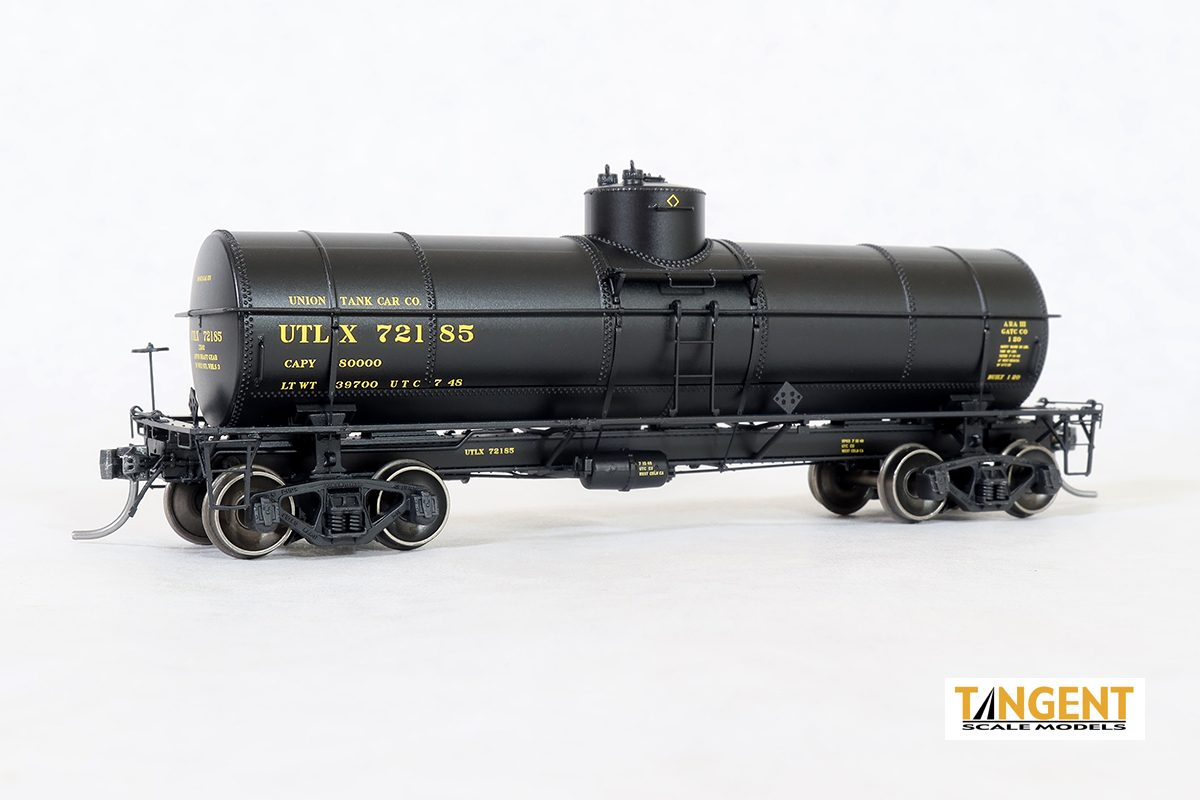
UTLX 72185 - Third Run GA Type 17 8K Tankcar - Tangent linked photo.

I never picked up this version for UTLX, so I'm using the linked stock photo from Tangent's page.  Checking the 1950 ORER, the UTLX 71000-79999 series had 4455 cars of 40-tons (probably 8k capacity), 794 cars of 50-tons (probably 10k capacity) and two other cars with special linings in that series.  The 4455 car block shows that this is one of the larger groups of cars.  I should note that Proto2000 has also produced their ACF Type-21s in this same number series, so not all of the 4455 cars rating at 40-tons are these GA Type-17s. In either case, I'm going to snag one of these new run cars before they sell out.

New run of GA Type 17 UTLX 8k models - Oct 2022


American Car & Foundry (ACF)


Type-21 - Proto2000/Walthers - Late-1990s to Present


10K Gallon


UTLX 10343, ACF Type-21 10K tankcar, photo linked from Walthers website.

Proto2000 released the 8K gallon version first, then a couple years later the 10k uninsulated version came out.   Proto2000 are supposed to be historically correct numbering.  Interestingly, this series overlaps with the new Tangent Models GA Type 17 8k models.  Only 198 cars in the 26-12749 series were rated for 50-ton weight capacity, suggesting how few Type 21 10k and GA type-17 10k cars there can be in these number series.

The older kits that I have of this car show numbers in the 60k-series (UTLX 60350 is one I have), which seems to be correct in that it's a 50-ton car and not in a noted series of 40-ton cars within that series.  The 60000-67999 series consists of 4493 cars of 50-tons capacity (probably 10k gallon cars) with 555 rating at 40-ton capacity (presumably 8k gallon cars).

8K Gallon


UTLX 77640, ACF Type-21 8K Gallon.  Looks like this one is missing the dome platform. JHill photo 2011 LMRC Roster.

Unfortunately, most of my P2K UTLX Type-21s have either not been built or took damage like this one.  Proto2000 are supposed to be historically correct numbering.  Interestingly, this series overlaps with the new Tangent Models GA Type 17 8k models in the 71-80k series, so it would seem that the 4455 cars in that series that are shown as 40-ton, 8k cars are not all the same mechanically.

10K Gallon - Insulated - Not Used by UTLX


Type-27 - Intermountain - Late 1990s to Present


10K Gallon


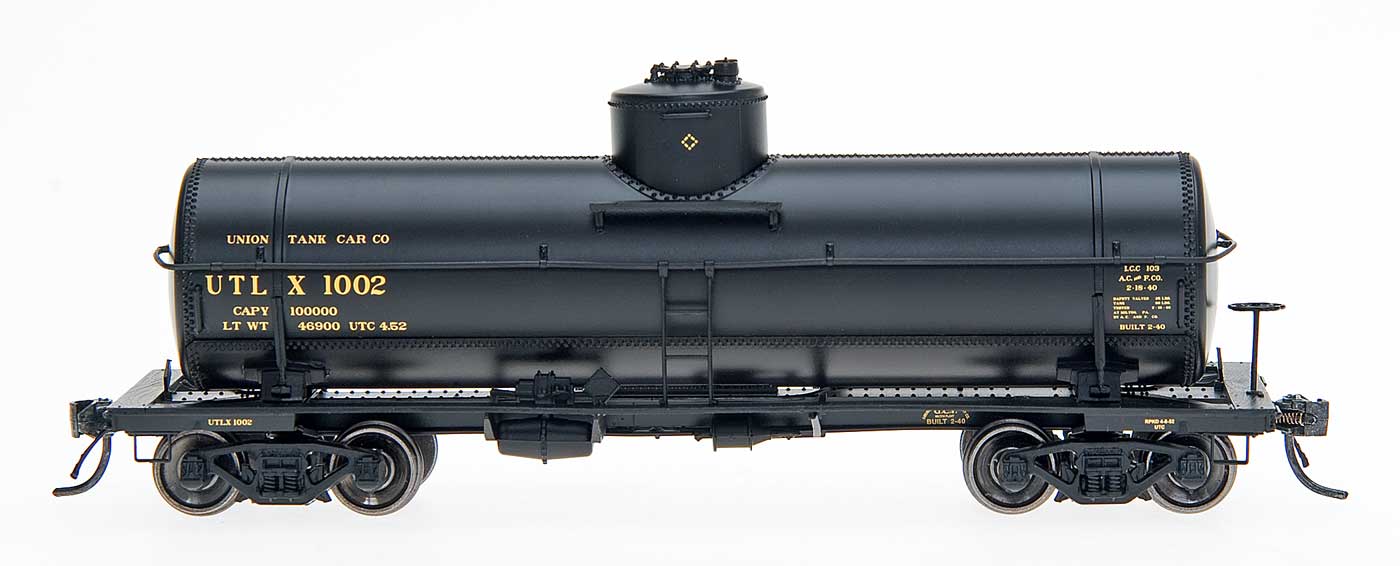
UTLX 1002, Type-27 10K tankcar - IMRC website photo linked.

The ACF Type-27 tank cars are built on a longer frame and smaller diameter tanks than the Type-21s.  The model shown, UTLX 1002, is in the middle of the lower end of the roster and falls within the Note B cars of 976-1026.  Again, a very small group of cars considering the UTLX fleet size.  IMRC currently shows the following numbers available:

Built (Tare Date): Built 2-40, UTC 4-52
Stock Number / Car Number
-37 982, -38 996, -39 1002,
-40 1007, -41 1015, -42 1028

It would seem that the 1028 is two numbers higher than the last 50-ton car and is back in the 40-ton, 8k gallon car number series.


8K Gallon


UTLX 17362, ACF Type-27 8K gallon tankcar - IMRC website photo linked.

The IMRC ACF Type-27 8K tank car is also built on the longer frame of the Type-27 design, with the smaller tank diameter.  ORER shows the 16000-17799 series with 1437 cars of 40-ton, 8k gallon nominal capacity.  Only two cars in the series have notes on being 30-ton capy, probably 6.5k gallon (UTLX 16121 & 16445) and 10 cars of 40-tons with special liners. (UTLX 17001, 17065, 17069, 17211, 17295, 17392, 17567, 17624, 17668, 17705 lined).  So it seems IMRC came up with reasonable car numbers with their research.

Built: 7-37
Stock Number / Car Number
-07 17319, -08 17334, -09 17356,
-10 17365, -11 17371, -12 17382

Previously Released Numbers
-01 17308, -02 17317, -03 17330,
-04 17362, -05 17375,
-06 17389,

1948-1951 LPG Tankcar 11k Gallon - Atlas - Early 2000s


UTLX 96269, 11K gallon insulated, welded, 300PSI LPG tankcar from Atlas.

Atlas produced a new set of tooling in the early 2000s replicating the ACF's 11k gallon LPG tankcar, while a little off-topic from the general service tank cars that I'm talking about in this article, I do want to point it out.

The UTLX 96012-99999 series are the new LPG cars totalling 2274 cars in the 1950 ORER with only 29 cars in the series showing as 40-ton cars, which are probably some other design.  Both cars blocks in the series are classified as TPI = Tank, Pressurized, Insulated.  The Atlas model represents the fairly standard of the late 1940s LPG car meeting the ICC-105A-300-W specification.

Union Tank Car (UTC)


UTC X-3


Rapido's pre-production UTLX 10K X-3 Tank car - Photo linked from Rapido's website

The X-3 series of tankcar designs have been offered in resin, but never before in plastic tooling or R-T-R.  So Rapido's announcement that they're doing a 10K gallon UTLX X-3 car is very good news, as we can finally balance out our steam-diesel era UTLX fleets.

10K Gallon - Rapido, new project 2022+


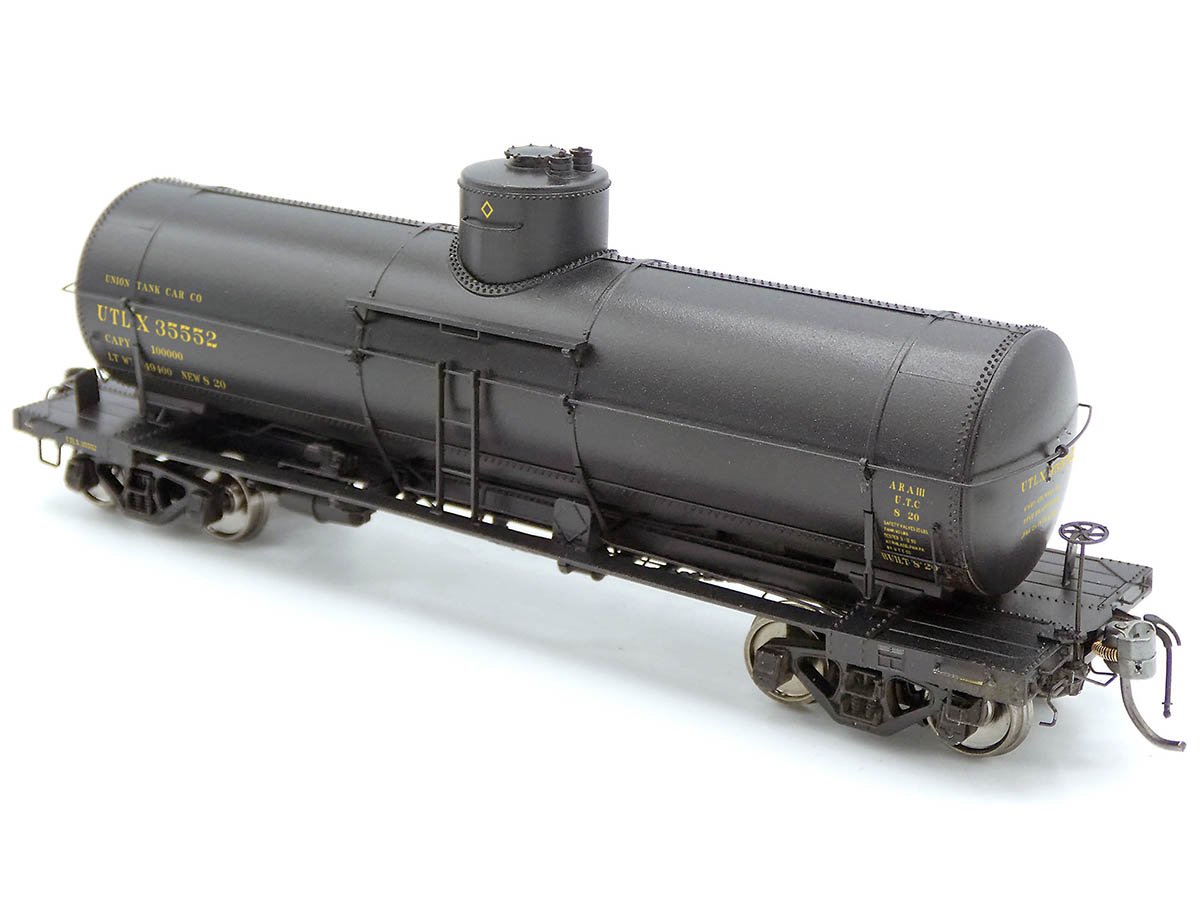
The first release of Rapido cars look like they're numbering into the 26000-42999 series, including 28714 in the 1920s version, 28941 in the 1930s lettering scheme, and 35552 is one of the cars in the 1950s version with AB brakes.  This massive group of 17,000 numbers 6235 cars show active in 1950 with 50-ton (10k gallon) capacity and only 174 cars of 40-ton (8k gallon) capacity in the series.  It doesn't appear that Rapido has announced exactly which numbers they'll be doing as of Oct 16, 2022.  The numbers I meantioned here are what their render-artwork shows and one pre-production 1950s model is 35552.  However, with 13,000 cars of the 10k gallon X-3 design, that accounts for almost 25% of the UTLX's whole fleet.  So we can clearly see how we've been missing this very signature car in the steam era fleet.  Several other leasing companies and railroads besides UTLX are planned in this first release.

Rapido Website Link: UTLX X-3 Tankcar

Among the other leasing and railroad owned X-3 Rapido is also producing besides UTLX, I believe that PX is Products Tank Car.  The PX cars use the UTLX yellow on black standard lettering.

8K Gallon


Only available in resin kit form.

6.5K Gallon


Only available in resin kit form.

In Closing


T&NO 838 with variety of oil and chemical tank cars, Texas Feb. 25, 1952 - Robert Yarnall Richie photo - George Lane collection, digital collection at DeGolyer Library, Southern Methodist University, Texas.

I'm hoping that this blog post will help my fellow modelers learn and develop a roster plan for their layouts which will have a good balance of UTLX and tank cars in general.  If nothing else, to keep a weather-eye out for what models are floating around on the NIB and second-hand markets for the limited production models, such as Tangent or the various P2K kits that have been produced over the last 25 years, but aren't currently "in production" to build a fleet from.  Nothing worse than walking into a hobby shop and having your brain go blank of exactly which cars were right and which ones was I supposed to avoid as "Fobbies"?  Hopefully, this page can be a "oh, yeah, NightOwl did an article on that, let's pull it up on my phone." to solve the question.

Jason Hill


Modeling SP B-50-series Boxcars (Part 5) - B-50-13/14 from Accurail or resin kits

SP Pre-War Boxcar (Part 1) B-50-18/19/20/21/23 classes

SP Post-War Boxcars (Part 2) B-50-24/25/26/27/28/29 classes

West Bakersfield (Part 1) - Laying Out Industries - Shell Oil of Calif, Union Oil of Calif, Pennzoil

Thursday, June 16, 2022

ATSF 129782 - Bx38 - Weathering with Pencils & Acrylics


IMRC's WWII Emergency Boxcar lettered for Santa Fe Bx38 class.

To add some variety to freight car fleet on my Jawbone Branch layout, I picked up this IMRC boxcar about 5 years back.  These cars are really cool as they add a unique look to any freight train with the composite doors.  These cars are also rather tall for composite cars at 10'6" IH, which is the same as the post-war steel cars and some of the 1937 AAR cars.

Prototype Weathering Reference


ATSF 213481, a Bx12 class boxcar as an example of weathering on Santa Fe boxcars, circa 1957. Tim Logan collection

While I don't have a prototype photo for the War Emergency car, and I don't have a resin Bx12 class car, which are really cool with the raised roofs.  Instead in this post I'll be experimenting with my acrylic weathering and Prisma Pencil weathering on.

Starting Point


Unweathered IMRC WWII Emergency Boxcar design, ATSF 129782, Bx38.

All the cars on my layout get at least a bit of weathering, so this car which is about 5-8 years old during my 1949-1954 era layout, so would be starting to show some weathering.

Weathering Process


Let's first look at the weathering materials that I will be using.

PrismaColor pencil set, Michael's art supply had single pencils as well.

Apple Barrel acrylic 'craft' paints from Walmart.

Applying Weathering to the Model


I started with some light pencil experimenting on the Bx38.  Fairly soon, I wanted to apply the general color adjustment with the acrylic paint.  I used Pavement and choice of a couple of the medium-dark brown to tone down the paint on the car generally.  Territorial Beige is used to apply the 'dust' effects along the lower part of the car.

Several passes with brown pencils and some boards picked out for gray pencils to show aged boards.  The Apple Barrel paint helped give a bit of extra 'tooth' for the pencils to adhere to the model.


Completed pencil only weathering experiment.  I think it's a little too contrasty, so I knock down the colors a bit with some Apple Barrel acrylic wash.


Trucks weathered with acrylic paint and Pavement on the wheel faces.


Acrylic weathering finished.  Time for a little more pencil work.


I decided to only apply the extra pencil work to the right side of the car.  The left side at this point stopped with the 1st acrylic overcoat.


Underframe weathered with dirty brown-pavement color.


At this point I sealed the pencil work with a coat of Dullcote.  I may do another very thin wash to blend the colors again slightly.

Roof Weathering (Edit)


I did some dabbling weathering on the roof with applications of Dark Gray, Pavement, some selected brown/rust colors and a few applications of Golden Sunset AppleBarrel acrylic, which was a mistake!

ATSF 129782 with overboard roof weathering

I did a final over-wash of Pavement to tone down the dabs of Golden Sunset, which was too bright. 

Black roof weathered

I'm pretty happy with how it turned out now that the Golden Sunset yellow is toned down.

In Closing


Right side of ATSF 129782 in 'soft' cloudy NV evening light

Finishing touches include patching out the tare date and last 3-digits of the LD LMT and LT WT.  New last 3-digits of the weights and tare station and date.  I decided to set this car up as an Santa Fe Bakersfield reweighed car from August, 1949.  

Left side of ATSF 129782 in 'soft' cloudy NV evening light

Chalk marks with the white and light gray pencils are also applied along the lower sides of the car.

IMRC's WWII Emergency Boxcar lettered for Santa Fe Bx38 class in natural summer NV sunlight.

I'm looking forward to getting the LED lighting over the Jawbone Branch finished, as it will provide better lighting for photographing the weathering on these cars.

Jason Hill

Related Articles:


Weathering NP 11661 - Rapido Double-Sheath Boxcar - with Acrylics and Prisma Pencils


SP 65ft Mill Gondolas - Examples of Athearn 65ft Mill Gondolas including weathering tips.

Open Loads (Part 1) - Building Steel Loads - Also showing weathering on gondolas

SP Prewar Boxcars (Part 1) B-50-18,19,20,21,23 Classes - History and Modeling with Weathering

SP Jawbone Branch (Part 4) - Freight Car Roster - Various cars planned for my layout.